
Choose a counting game that makes the number useful: deliver three blocks, set places for four toys or check a small collection. Keep the objects visible and count each one once.
Choose a counting job
A useful counting game gives the number a purpose: deliver three blocks, set places for four toys or check a small collection before putting it away. Keep the objects visible and connect one number word with each item. After counting, say the total again so that the final word means how many there are, not merely where the spoken sequence stopped.
These twelve games practice different jobs. Counting an existing group is not the same as making a requested amount or comparing two groups. A child may manage one comfortably and need help with another. Begin with quantities that leave room for conversation, often one to three, then adjust from what you notice. The examples below are flexible starting points rather than age requirements.
Use large, suitable play materials and a clear surface. Printed counters should be kept large enough to handle, with adult preparation where needed. Children can point, move objects, sign or direct an adult. Spoken number names in another home language still support the mathematical task. Writing numerals is optional unless recognizing or recording the symbol is the particular skill you chose.

Six everyday counting games
1. Toy picnic
Put three toys at a pretend picnic and bring out four cups. Give each toy one cup, then look at the cup left over. Count the toys and the cups that are actually needed. Ask whether the spare cup has a guest. The correspondence makes three useful before any written numeral appears. For an easier version, use two toys and exactly two cups.
2. Block delivery
- Place the numeral card 3 beside a building space and ask for three large blocks.
- Let your child take blocks from a larger supply and stop when the requested group is complete.
- Check the delivery together, then use it to build.
This adds a stopping decision to counting. If the child keeps taking blocks, move each delivered piece into a separate space and pause at three.
3. Count the footsteps
Choose a short, clear indoor route and take four comfortable steps together, saying one number for each step. Stop after the fourth. If stepping is not suitable, move a toy along four large floor marks or tap a hand four times. Actions disappear as they happen, unlike objects that remain available to inspect, so keep this version short and avoid confusing speed with successful counting.
4. Check the toy garage
Park two toy vehicles in separate spaces. Count them, move them around within the garage and count again. No vehicle has arrived or left, so there are still two. Then add a third and discuss what changed. The contrast helps separate rearranging a group from changing its amount. Let the child recount to verify the result rather than demanding that they immediately know it.
5. Set a pretend table
Give each of four toy guests a plate, then each a spoon. Compare the four plates with the four spoons by pairing them. The objects look different but the groups match in number. An adult can ask for one missing spoon after deliberately leaving a guest without one. Keep the pretend materials safe and distinct from any sharp or breakable real tableware.
6. Pack and check
Choose five large pieces from a familiar construction set and place them in a tray. Count them into a container, moving each piece once. Tip them out and arrange them differently before checking again. Give the task a practical finish: all five selected pieces are packed. Do not insist on counting an entire toy collection when a small selected set demonstrates the same idea more clearly.
Six games with cards and mats
7. Find the matching number
Count a visible group of three counters, then offer the number cards 2 and 3. Ask which label belongs beside the group. If your child names the wrong card but counts the objects accurately, model the numeral match rather than making them recount repeatedly. Recognizing the printed symbol adds a separate demand. Change the positions of the two cards on the next turn.
8. Fill a counter mat
Draw or print four large spaces and place one suitable counter in each. Count the covered spaces and look for any empty or doubly filled positions. Remove the mat afterwards and count the same four counters as a group. The spaces are a temporary support for keeping track; they should not become a rule that counting only works when every object has a printed circle underneath it.
9. Restore a missing collection
Make a group of three cards showing familiar objects, count it together, then cover one card while the child watches. There are two visible cards and one hidden card. Ask what would restore the complete visible collection, then reveal the hidden card. For a first round, keep the cover visibly over the card so the challenge does not depend on remembering an unexplained disappearing object.
10. Match two different arrangements
Show three counters in a straight line and three in a loose triangle. Invite the child to match them one for one or count each group. The layout and spacing differ, but the amounts agree. If the longer-looking group seems to have more, bring pairs together and investigate. Avoid explaining only by assertion; the child needs a way to check the claim with the materials.
11. Make a picture order
Draw two large windows on a pretend house and give the child an order for two curtains, represented by paper rectangles. They deliver one to each window and check the total. Repeat with three windows if wanted. The adult drawing need not be elaborate: the clear destinations make the number useful. Keep extra decoration away from the items you are asking the child to count.
12. Be the checker
Let your child choose a number card from a small familiar range while you make a group. Sometimes make it correct and sometimes announce that you need help checking. If the card says 3 and you bring four blocks, ask what needs to change. Removing one is a meaningful correction. Your child can demonstrate the answer without needing to describe subtraction or write an equation.
Read the three setups in the picture
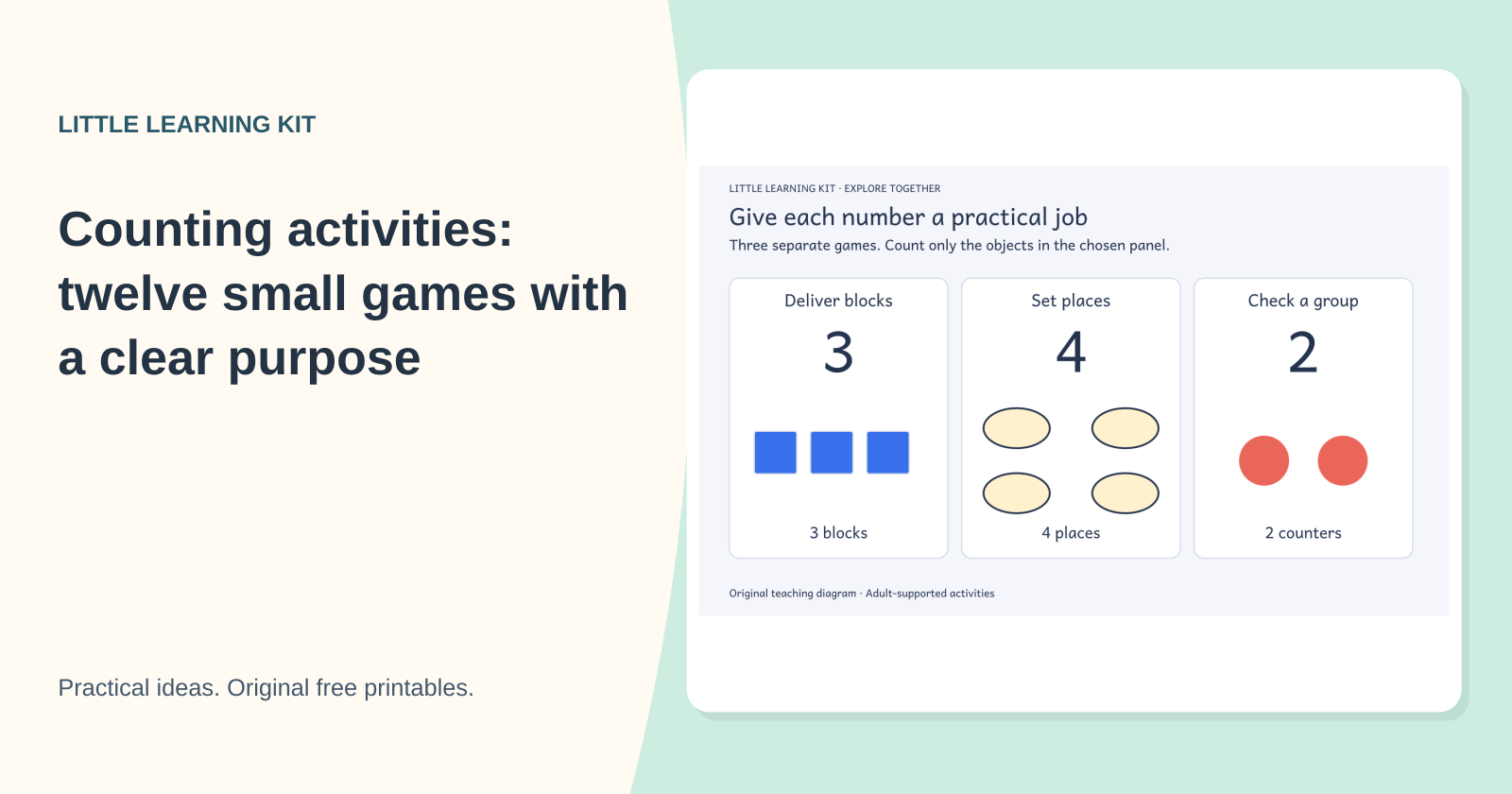
The teaching illustration shows three separate activity setups: a delivery card labeled 3 beside three blocks, a picnic card labeled 4 beside four places, and a checking card labeled 2 beside two counters. Count only the objects inside each labeled activity panel. The three panels are separate tasks, not one collection with a single shared total. Use them to choose a game, then make your own real setup.
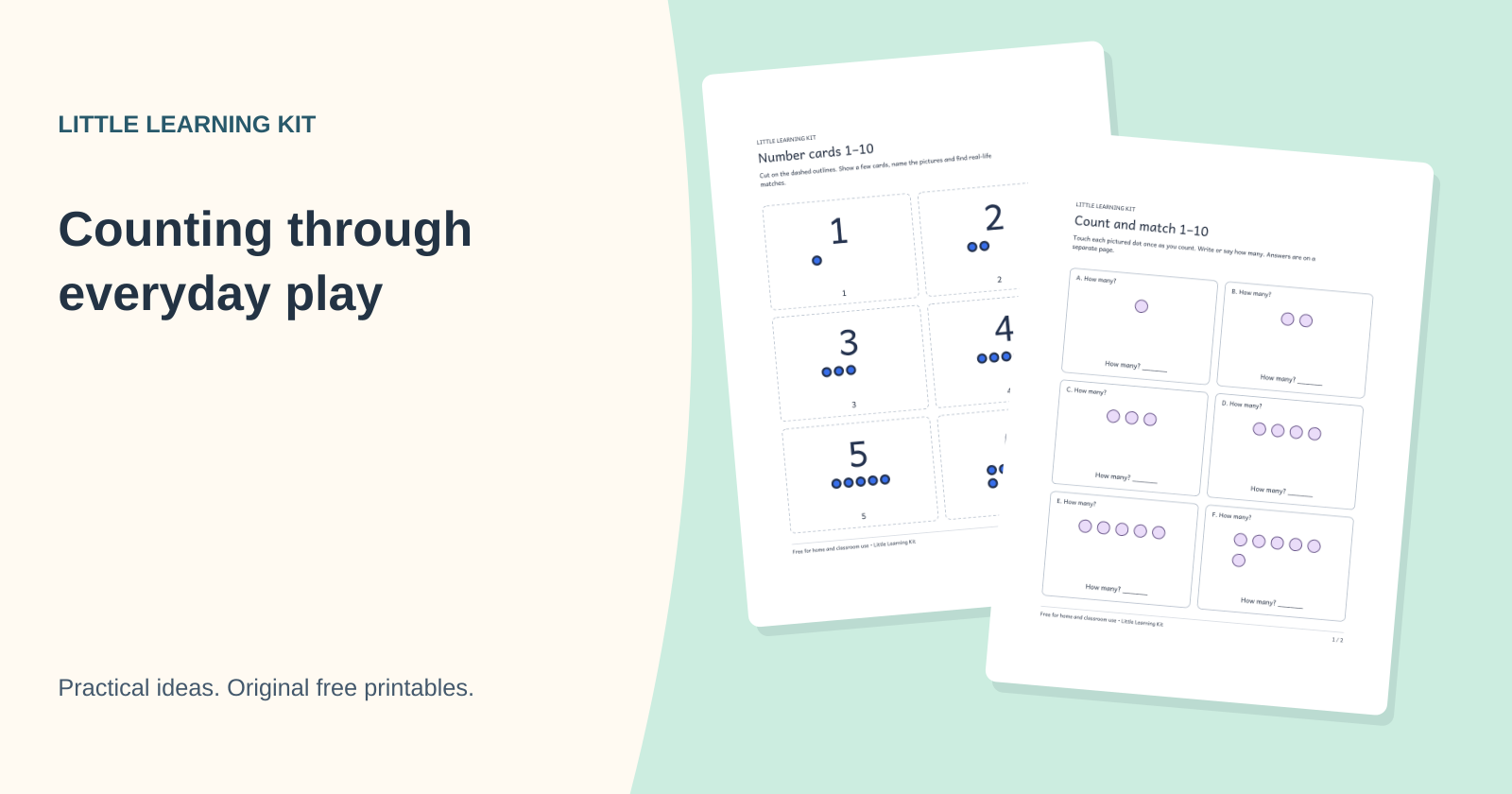
The count-and-match sheets can support games seven and ten, while counter mats support game eight. Print only the page you plan to use. A full pack can become visually busy when the intended challenge is keeping track of a small group. Cover unused rows with plain paper if a sheet contains more than you need today.
Adapt the difficulty from a specific observation
If the child says number words faster than they touch objects, slow the physical action and move each counted item into a finished group. If the word sequence breaks down, keep the collection small and model the next word together. If they count correctly but answer how many by starting over, restate the total after the final touch and invite them to show the amount.
Increase only one feature at a time. Moving from three lined-up blocks to eight scattered pictures changes quantity, layout and representation together. A more informative next step might be the same three blocks scattered, or four blocks still in a line. If the activity becomes frustrating, returning to the clearer version is a sensible adjustment rather than a backwards step in a fixed programme.
| Purpose | Useful games | What to notice |
|---|---|---|
| Count a set | Garage; pack and check | One count per object and a final total |
| Make a set | Block delivery; picture order | Stops at the requested amount |
| Compare sets | Pretend table; different arrangements | Pairs objects or checks both totals |
| Connect symbol and amount | Matching number; be the checker | Identifies the numeral separately from counting |
Choose tomorrow’s game without making a score sheet
An informal note such as “Moving each block helped” is more useful for planning than a vague label of good or bad at counting. Keep the number, material and support in mind, then choose a different story for the same skill. A child who enjoys deliveries may not want a worksheet the following day, even if both practice making a requested amount.
NCETM’s counting guidance distinguishes number-word sequence, matching words to objects and understanding the total. The routines here are original examples built around those different demands. They are intended for shared play with adults, not a timed assessment. Finish when you have had a useful exchange; there is no requirement to complete all twelve games before moving on.
For a related next step, explore Counting through everyday play or One-to-one correspondence: matching one object to one count.
Sources & further support
General parent support, not an individual assessment or a school programme. Check your child’s setting for its chosen approach.