
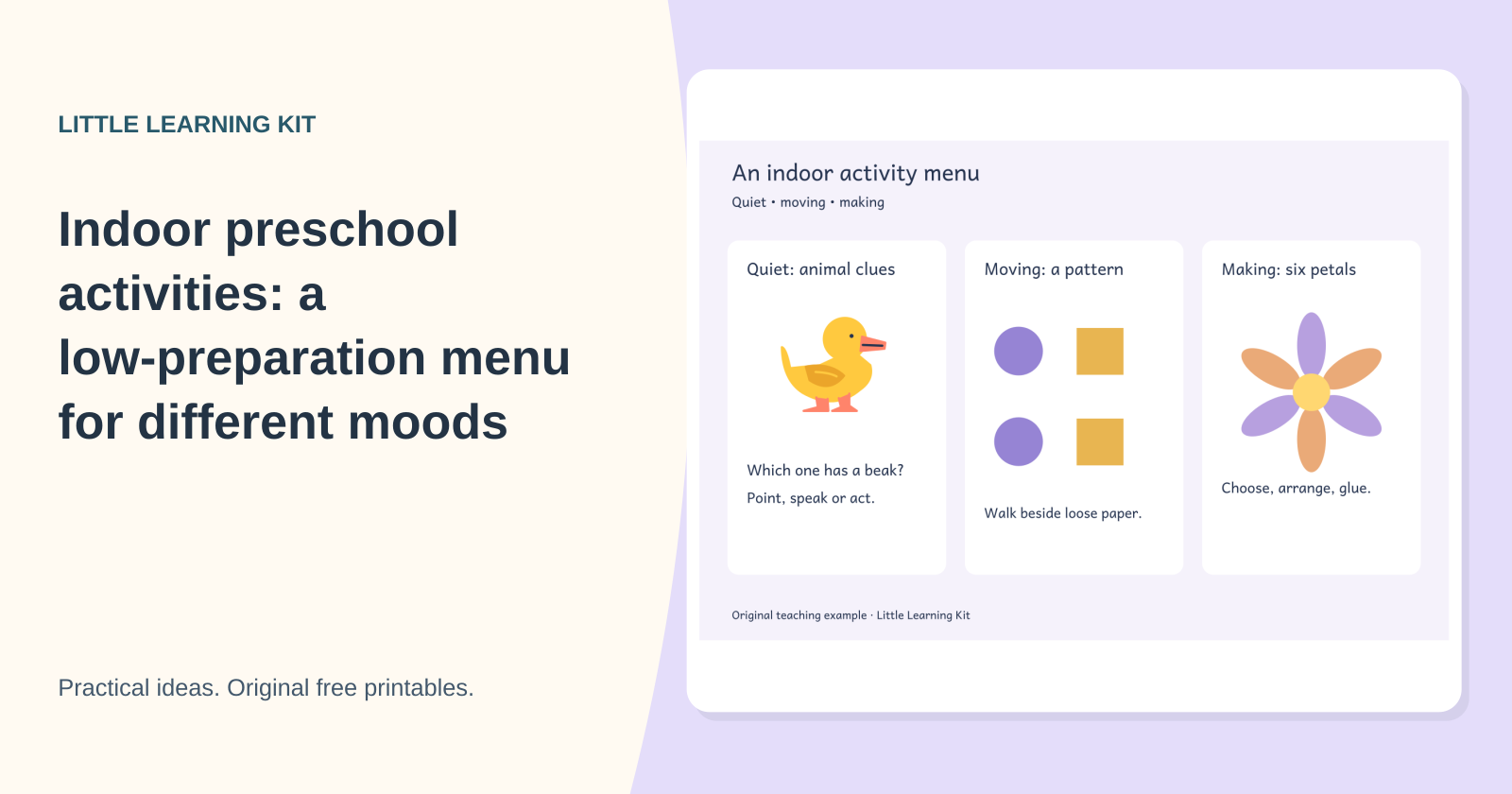
Choose an indoor activity by the space and energy you have: a quiet picture game, a small movement hunt or a making activity. Start with one invitation, keep the materials simple and leave room for children to change the game.
Choose the kind of afternoon you actually have
A useful indoor activity does not need a special theme, a shopping trip or a parent performing all afternoon. It needs a manageable starting point. Look at the available space, the materials already within reach and how everyone is feeling. A child who has been sitting for a long time may enjoy carrying picture cards across the room. Another may want an adult nearby and a quiet book. Neither choice needs to become a full lesson.
The nine activities below are a menu, not a timetable to complete. Each includes a way to begin, something to say and an obvious stopping point. Select one or two and keep the rest for another day. Preschool is a broad label across countries and settings; adjust the materials and conversation to the individual child. For siblings, the same activity can have different jobs without assigning a competition or a winner.
Prepare the space before offering the game
- Clear a small area rather than rearranging the whole room. Keep walking routes away from doors, stairs and trailing cables.
- Use large pieces and age-appropriate materials, especially when younger siblings might put objects in their mouths.
- An adult should manage cutting and supervise materials as needed.
- A quiet activity can take place at a table, on a mat or beside an adult; it does not depend on a particular sitting position.
Put a basket or tray nearby for finished materials. This gives you an easy ending and avoids a large mixed pile at the end of the day. If preparation takes longer than the likely play, simplify it. Three picture cards are enough for a first hunt. A blank sheet can be a stage. The best version is one you can comfortably start with the time and attention available.
| Activity | Space | Preparation | Clear-up |
|---|---|---|---|
| Describe and find | Table or lap | Three animal cards | Return cards to envelope |
| Card treasure hunt | One clear room | Four reachable cards | Collect and count cards |
| Pattern path | Clear floor or table | Six paper shapes | Stack the shapes |
| Flower craft | Covered work surface | Print and adult-cut pieces | Save two spares; dry picture |
| Message post | Small table | Paper, crayons, box | Keep or deliver messages |

Three quiet activities
1. Describe and find
Choose three animal picture cards with familiar animals, such as a cat, duck and cow. Place them face up. Describe one without naming it: I am thinking of the animal in our picture with a beak. Pause and let the child point, name or hand you the duck. Then show which detail helped you. Use the picture as evidence; avoid claiming that every real duck looks exactly like the drawing.
Swap roles. A child might say moo, make a wing movement or simply look towards their chosen card; accept that clue and describe what you noticed. To make the game easier, use two cards. To extend it, add another bird and ask for a second clue so the answer is clearer. Finish after both players have chosen an animal, or while the child still wants another turn. Leave the cards out if they become characters in a different game.
2. Story theatre
Read the Sam and the cat story together, with the adult taking any words the child does not yet know. Put a folded sheet upright as a simple backdrop and choose a cat card or toy as a character. Ask the child which moment they would like to act out. Retelling one event is enough; there is no need to memorise the text or perform the whole story in sequence.
An adult can narrate while the child moves the character. Then change one detail deliberately: What if the cat hid behind our chair? Explain that this is your new version so the child does not have to reconcile it with the printed story. Someone interested in reading can find a familiar word on the page; someone interested in acting can supply a sound or movement. Finish by putting the character to bed or closing the paper stage.
3. Picture museum
Set out three drawings or cards on a low surface and pretend they are a tiny exhibition. Invite the child to choose the order and tell you about one item. Write their description on a small label if they want. A museum visitor, perhaps another adult or a toy, can ask one genuine question: Which bit did you make first? Keep the child's explanation, even when it differs from what the picture first suggested to you.
Younger children can bring an object to stand beside a matching picture. An older sibling might make an entrance ticket or choose a title for the exhibition. Do not require all the pictures to be neat or finished. The point is to select and explain something worth showing. End with a short visit, then ask which item should stay on display and which can go into the folder.
Three activities with a little movement
4. Card treasure hunt
Put four large shape cards in visible, reachable places around one clear room. Explain that this is a walking hunt. Give a clue such as Find the shape with three straight sides, or show a matching triangle card if the words are unfamiliar. The child brings the card to a central mat and checks it with you. There is no timer and no need to hide things behind furniture.
For a first hunt, let the child watch you place the cards. For a more challenging version, offer two clues or invite them to hide the cards for you. A child who prefers to stay in one place can direct an adult towards the card or use a small tabletop version. Finish by checking that every card has returned; counting the found cards gives the hunt a practical ending rather than a score.
5. Floor pattern path
Use six large paper shapes on a clear floor to build a circle, square, circle, square, circle, square pattern. Walk beside the paper rather than on loose sheets, which can slide. Say the pattern together while pointing. Remove the last square and ask what would keep this particular pattern going. Show why square fits by returning to the repeating circle-square unit. A different answer may begin a new pattern, which you can explore separately.
A smaller version needs only four shapes on a table. To extend the activity, let the child make a pattern for you, perhaps circle, circle, square repeated twice. Read it together before predicting the next item. Do not make balancing or jumping part of the task unless you have a suitable safe surface and a separate clear plan. The learning here is in noticing the order, not navigating a slippery obstacle course.
6. Color delivery
Place two sheets of coloured paper, or two labeled color cards, at one end of the room. Gather four large familiar objects in those colors. Ask the child to deliver each object to a matching home. Choose objects with a clear main color for the first round. A patterned sock can be discussed later because it might reasonably belong with more than one group.
Change the job by making the child the dispatcher: they choose an object and tell you where it belongs. Carry one item at a time, walk together and leave the route clear. If no suitable objects are available, draw large coloured circles on scraps of paper. Finish when the delivery basket is empty. You can then reuse the objects for pretend shopping, or return them to their real homes together.
Three making and building activities
7. Six-petal flower
Open the flower petal craft and prepare the base and pieces at the same print scale. The pack provides eight petals; its suggested flower uses six, leaving two spare. An adult can cut the pieces in advance. Let the child choose six and move them around the center before any glue appears. The finished flower can differ from the example while still using the chosen six petals.
If printing is inconvenient, draw a center and let the child add petals with crayons. This is a drawing version, so do not insist that it matches the cutout pack. A sibling could describe the colors or count the petals while another arranges them. End by choosing a place for the flower to dry. Save the two unused pieces in a labeled envelope rather than scattering them among unrelated cutouts.
8. Small-world shelter
Offer a cardboard box, a few large blocks and one toy animal. Ask where the animal might rest. Let the child decide whether the box becomes a house, a cave or something invented. Help with practical problems by describing them: The doorway is narrower than the toy. Then try a change together. Avoid rebuilding the shelter into your own preferred design as soon as the first wall falls down.
Extend the conversation with location words such as inside, beside and behind. An older child might draw a sign or plan a second entrance. A younger child may simply enjoy putting the animal in and taking it out. Both can use the same shelter. End by visiting the finished home or taking a private family photograph before dismantling it; the activity does not need to become permanent household storage.
9. Folded message post
Give each participant one sheet of paper and a crayon. Fold the sheet in half to make a card, then ask who in the room, or which toy, should receive a message. The child can draw, make marks or dictate words for you to write. Use a box as the postbox and let everyone deliver and open their messages. An envelope is optional, so there is no extra cutting required.
A child who writes comfortably can add a short word; another can choose the recipient's picture. Read dictated messages exactly as agreed rather than correcting them into a polished adult sentence. If someone does not want to give their drawing away, make a pretend delivery and return it afterwards. The game is about communicating and taking turns, not requiring a child to surrender something important.
Make one realistic rainy-afternoon plan
Choose a starting activity and a loose ending, not nine back-to-back stations. For example, begin with a walking card hunt, have an ordinary snack when needed, then offer story theatre or free play. Keep the making activity as an optional choice rather than a promised reward for completing the hunt. You can show two pictures if knowing the immediate sequence would help; see the now-and-next guide for that smaller format.
For mixed ages, share the materials but separate the questions. During the shape hunt, one child can match an identical picture while another describes corners. During the flower activity, one can place petals while another counts the group. Avoid asking the older child to supervise or assess the younger one. An adult remains responsible for safety and for keeping the shared materials workable for both children.
If the afternoon changes, change the plan aloud. A tired child may prefer the museum to the movement game, and a favorite shelter may occupy the whole session. A short visual schedule can reflect that change rather than locking the family into a promise. Put unfinished materials away accessibly, name what you enjoyed together and leave a simple invitation for another day.
Sources & further support
General parent support, not an individual assessment or a school programme. Check your child’s setting for its chosen approach.