
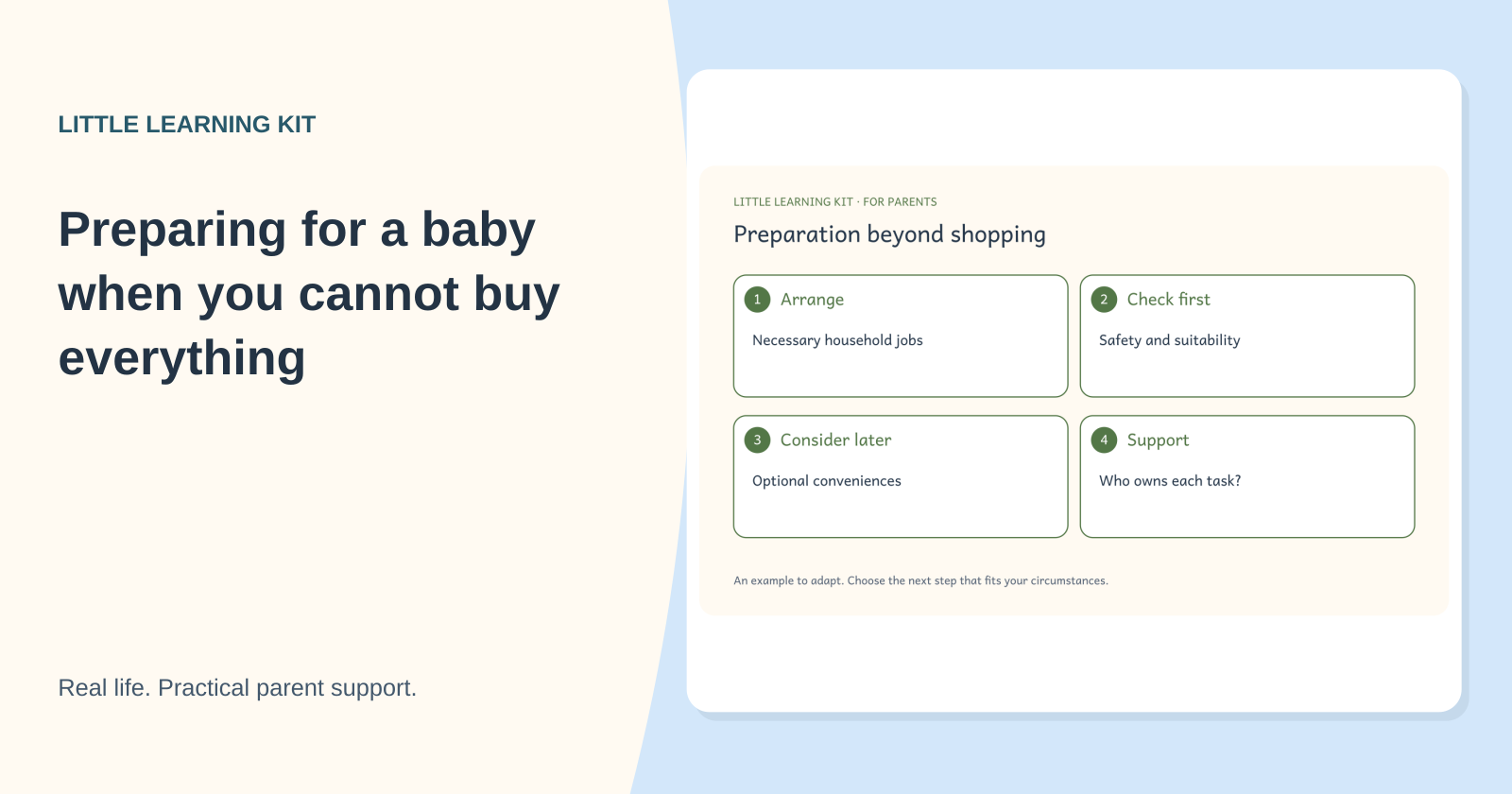
Organize around necessary jobs, questions to check and items that can wait. Safe essentials and practical support matter more than completing a retailer’s list.
Start with jobs the household needs to do
Preparing for a baby can become an endless shopping list. Every category contains another accessory, and every accessory is described as essential by someone who sells it. If money, space or support is limited, a more useful starting point is the jobs you need to carry out: safe sleep, feeding support, changing, clothing, travel where needed and care for the recovering adult.
This is a household planning guide, not a complete medical or equipment-safety manual. It helps you separate necessary preparation from optional purchases and identify questions for your maternity or healthcare team. Product standards, services and costs differ by country. Use the current official guidance for where you live rather than assuming a list written elsewhere is interchangeable.
The household examples below are hypothetical. Use them to ask what a purchase or arrangement would change for you. Someone else's favorite baby product may solve a problem you do not have, while a less exciting practical arrangement may make your first week much easier.
Make three lists instead of one

Label three columns: arrange before arrival, check first, and consider later. Put each proposed item or task in one column. “Check first” is particularly useful for equipment, feeding questions and anything whose suitability depends on your home or baby's circumstances. It is not a failure to leave a purchase undecided while you obtain the information needed to choose safely.
For each item, ask what job it performs, whether you already have a safe way to do that job and what would happen if you did not buy it immediately. A storage caddy may organize supplies, but it is not the same kind of need as a suitable sleep space. The exercise is about priority, not proving that all conveniences are wasteful.
Separate a bargain from a safety decision
The NHS newborn essentials guidance says that many items need not be new, while identifying the cot mattress and car seat as exceptions in its UK advice. Check that guidance and the actual product information before accepting second-hand equipment. A low price does not answer questions about condition, compatibility, missing instructions or history.
In the US, use local product and recall information, including the Consumer Product Safety Commission. Do not translate a UK product name and assume it meets US requirements. If you are unsure whether an item is appropriate, ask a relevant professional or manufacturer rather than relying on a seller's reassurance that everyone used one years ago.
Give safety questions their own space
For sleep, follow current official guidance rather than styling ideas from nursery photographs. The AAP safe-sleep guidance recommends placing babies on their backs on a firm, flat sleep surface and keeping soft objects and loose bedding out of the sleep space. Read its full advice for the US, including room-sharing and product requirements. The NHS provides the UK starting point through its baby-care guidance.
This short summary is not a substitute for the full advice or for an individual care plan. Write questions beside the official source: does this product meet the relevant requirements, is the mattress the correct fit, and who can check the arrangement if we are unsure? The action is to resolve the question before relying on the item, not to add more decorative bedding.
Feeding preparation also needs appropriate current information and support. Ask your maternity team or child's healthcare professional what supplies, cleaning arrangements and help fit your intended approach. Avoid bulk purchases based on a generic article and do not use homemade formula recipes. Keep the contact route for feeding concerns where you can find it, rather than expecting a shopping list to answer every question later.
Plan for the adult doing the care
Practical support belongs on a preparation list too. Map the help you can realistically ask for before turning a vague offer into another purchase or another job to organize.
Imagine a household with limited freezer space, no nearby family and a friend who can help once a week. In this example, buying many prepared meals may not fit the space or budget. The friend could instead bring a small grocery order or handle one practical errand, if they agree. The useful preparation is matching the offer to a real job.
List the ordinary work that continues after the baby arrives: meals, laundry, older children's arrangements, deliveries, appointments and messages. Identify what can be simplified and what needs an owner. If another adult is involved, avoid a plan where one person must notice every job and then ask for assistance. Agree who keeps track as well as who carries it out.
- Choose a small set of meals or food arrangements that fit your budget and facilities.
- Locate essential household supplies without stockpiling more than you can store.
- Agree how visitors can help and how you will decline visits that add work.
- Write down the appropriate maternity, newborn and routine healthcare contact routes.
- Check travel and older-child arrangements with the people or services involved.
For a parent preparing alone, the question is what can be made easier without assuming a partner will take over. Ask local services about available practical support and eligibility. If a service has a waiting list, include that reality in the plan. “There is no confirmed backup yet” is more useful than writing a relative's name because a template contains a blank box.
Make a visitor message before you need it
Sample wording could be: “We will let you know when visits work. If you would like to help, a small grocery drop would be useful. Please check before coming.” Change it to suit the relationship and your circumstances. You do not have to provide entertainment, a meal or a clean house to make someone else's visit worthwhile.
If offers of help are vague, give a limited option and make it easy to decline. Someone who cannot provide childcare may be able to return a parcel or bring a meal. Someone who wants photographs but cannot help practically is offering a different kind of contact. You are allowed to decide how much energy that exchange requires.
Keep the checklist open to revision
An item you postpone may later become useful. An item that suits another family may remain unnecessary for yours. Review the list when you have new information rather than treating an early purchase decision as a commitment to a whole parenting identity. Convenience is allowed; so is deciding that the cost does not fit.
Keep receipts, instructions and relevant product details together. If people buy gifts, suggest the specific items you have checked or a contribution to a genuine need. Do not let a gift list pressure you into accepting unsafe, unsuitable or unmanageable equipment simply because refusing feels awkward.
Before buying the next optional item, finish one practical arrangement: confirm the contact number, check the sleep-space question with the right source or agree who will handle the first grocery trip. A smaller shopping list can still be thorough preparation when it gives you safe essentials, clear questions and a realistic plan for the adults who will be doing the work.
Sources & further support
Sources checked 11 October 2026. General information; individual concerns need appropriate professional support.