
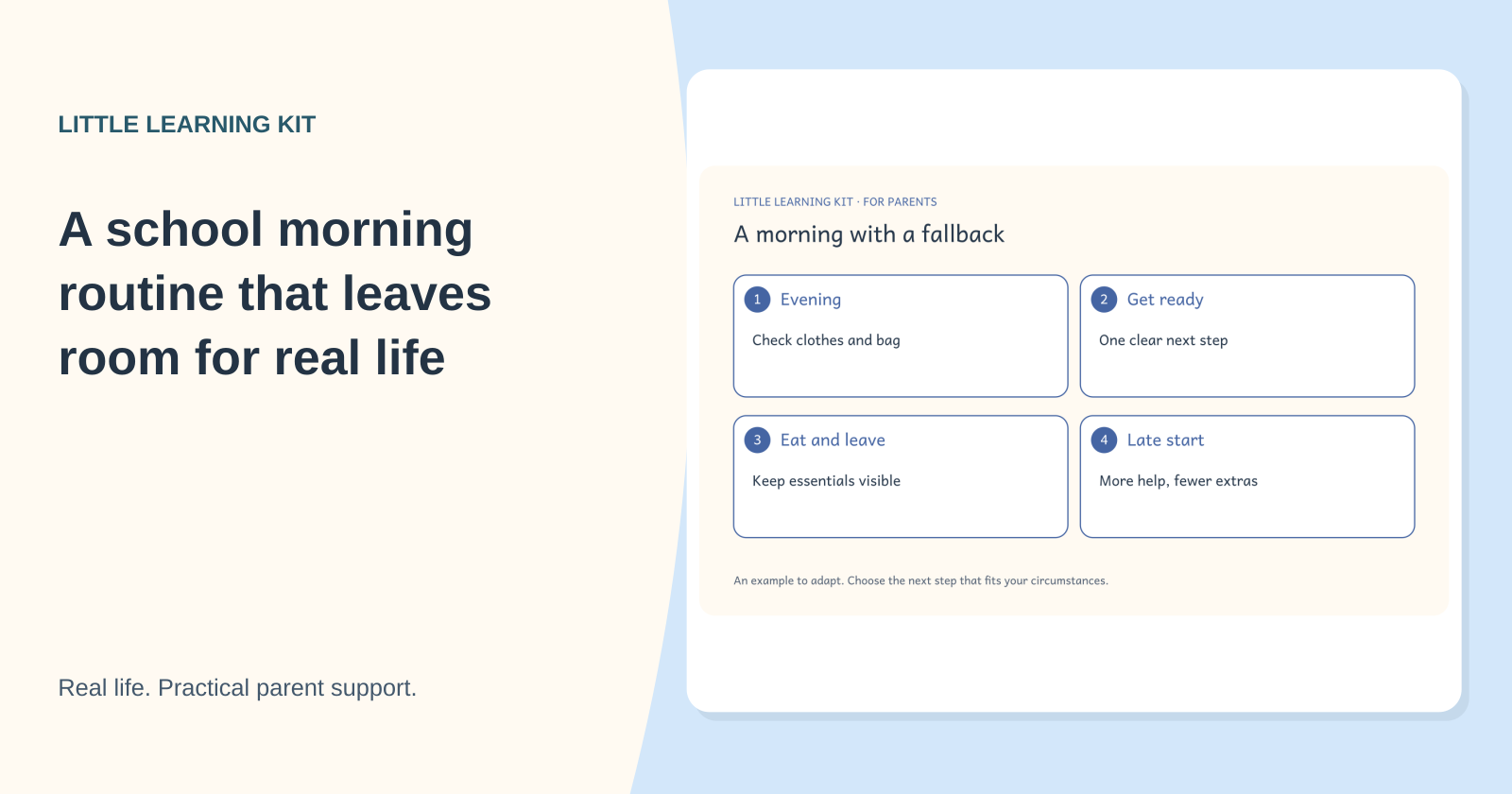
Find the point that gets stuck, simplify the next action and decide what can wait when you start late. A routine is a shared reference, not a promise of a perfect morning.
Find the point where the morning gets stuck
A school morning routine does not have to look impressive. It needs to get the necessary things done without requiring an adult to remember fifteen invisible jobs while also finding a missing shoe. If the plan only works when everyone wakes cheerful, nothing spills and you have spare time, it needs a version for an ordinary day.
Start with the point that repeatedly becomes difficult. Is it getting out of bed, deciding what to wear, leaving a game, remembering the bag or making the journey? “Our mornings are chaos” describes the feeling. “We spend ten minutes finding clothes after breakfast” gives you something specific to change. You do not have to fix the whole morning before trying that one adjustment.
The sequence below is an example to adapt. It assumes a child who attends school and an adult who helps them leave. Change it for breakfast clubs, home education, different carers, work shifts and access needs. A routine should describe your actual arrangements, including adult help, rather than an ideal of independence.
Build backwards from leaving

Write the time you need to leave, then the jobs that must happen before it. Check the school's actual arrival arrangements. A door that closes at a particular time, a bus departure and a flexible breakfast-club window create different plans. If the journey has an unpredictable section, allow for it where possible rather than allocating every minute to jobs inside the house.
Now sort the list into child tasks, adult tasks and shared tasks. Preparing medication according to the child's care plan, arranging transport and checking school messages are not jobs to transfer to a young child because the chart is full. Choose a small number of visible steps for the child; keep the adult administration on a separate note if it helps.
Move decisions out of the busiest moment
The evening check can be brief: locate clothes, check the bag and identify anything unusual tomorrow. You do not need a spotless hallway or matching storage boxes. A designated place may be a hook, a chair or a basket. It matters that people can find the items, not that the arrangement photographs well.
If another adult does the evening check, agree what checked means. “Bag ready” might mean a reading book is inside but the permission form is still on the table. Naming the contents avoids a vague handover. Older children can help decide what they will check themselves and what still needs an adult, with the arrangement revisited as circumstances change.
A short sequence to try
For this example, the child sees three headings: get ready, eat, leave. Under get ready sit the agreed washing, toileting and dressing steps. Under eat sit breakfast and any clean-up that genuinely fits. Under leave sit shoes, coat if needed and bag. Change the order if dressing after breakfast works better for you. There is no special virtue in this sequence.
Our visual timetable lets you choose and reorder pictures. Use only cards that match the real day. An older child may prefer a written checklist, and a child with different communication needs may need another format. The purpose is a shared reference, not decoration or a promise that the child will manage everything independently.
- Walk through the sequence together at a calm time and explain where help is available.
- Point to the current step and give one concrete next action, rather than reciting the whole morning.
- Keep essential items in the agreed place, or name their temporary location when that changes.
- Notice the first sticking point and adjust that demand before adding more reminders.
- Review the plan after a few ordinary mornings, including a difficult one.
Suppose the example child keeps returning to a half-built model before putting on shoes. An adult could agree a safe place for the model and say, “We are leaving now. Your model stays here for later. Shoes next.” This is sample wording, not a guaranteed solution. If leaving the model is still hard, the adult may need to help with the transition rather than keep pointing at the chart.
Give the late-start version its own rules
A late-start plan is easier to use if you decide it before you are late. Identify the essentials: the child's necessary care, appropriate clothing, something workable to eat, required items and a safe journey. Then identify what can wait. A beautifully completed checklist is not an essential in its own right.
In this example, the adult packs the optional activity away, helps more with dressing and leaves the bag check to the adult who is available. The child still knows the next step. That extra help does not have to be framed as a failure. You are responding to today's time and capacity, and can return to the usual division another morning.
Do not recover lost time through an unsafe journey, skipping necessary care or expecting a child to rush a task they cannot yet do. If you will be late, follow the school's reporting arrangements. Afterwards, look at what consumed the time. A one-off spill needs a different response from a journey that is consistently longer than the plan allows.
When the difficulty is more than organisation
Persistent distress about attending school deserves a conversation beyond the routine chart. Ask what the child can tell you, describe the pattern to the school and agree who will follow up. A clothing discomfort, a difficult handover, learning worries or a problem at school will not all respond to the same reminder. Avoid deciding the cause from a single morning.
The NHS support guidance for parents is a route to further information when emotional difficulties are involved. In the US, discuss continuing concerns with the school and the child's healthcare professional. Seek appropriate urgent help if anyone's immediate safety is at risk. A home checklist should never become a reason to postpone asking about a serious concern.
Sources & further support
Sources checked 11 October 2026. General information; individual concerns need appropriate professional support.