
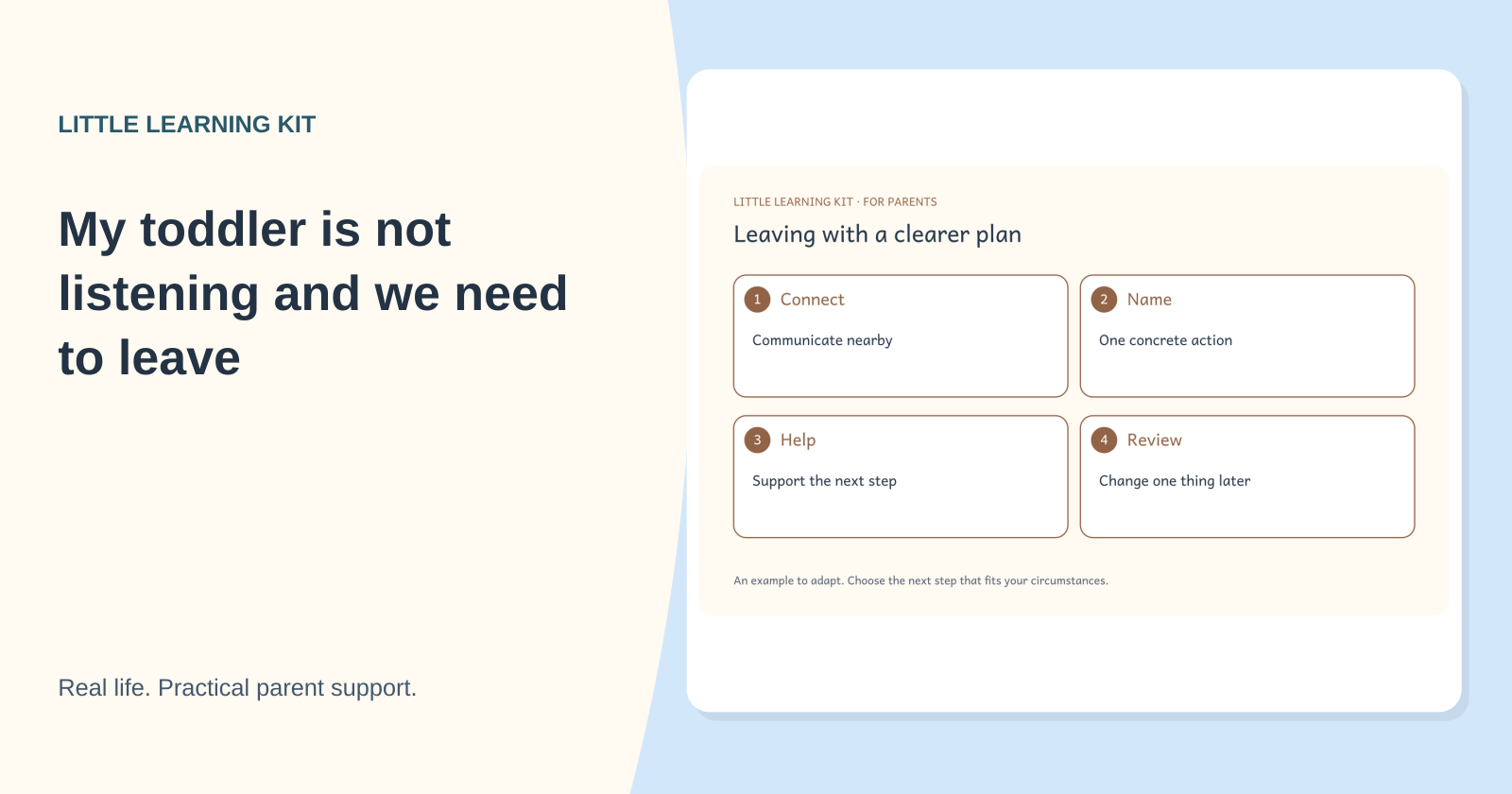
Make the immediate action clearer and offer the help needed to do it. Revisit the pattern later rather than trying to explain the entire day while leaving.
The instruction and the task may be different sizes
“Get ready, put that away, find your shoes and come here” sounds like one instruction when you are the adult who already understands the plan. For a toddler, it contains several jobs, a change of activity and some words whose meaning depends on the room. Before deciding a child is deliberately ignoring you, look at what you actually asked them to do.
That does not mean every refusal disappears when you find the perfect sentence. Sometimes a child understands and does not want to stop. Sometimes they need help, are absorbed, are upset or have not understood. A useful first response is to make the immediate task clearer while keeping the necessary boundary. You can investigate the pattern later, when you are not both trying to leave.
The hypothetical departure below shows how that process could work. The suggestions are options for a grown-up to adapt, not a developmental test or a claim about what every two-year-old should manage. Communication, sensory and access needs can change the support a child requires.
Make the next step visible and concrete

Johns Hopkins guidance on toddler listening recommends beginning with one-step directions and supporting transitions. Applied to our example, that means replacing the whole departure speech with the next action the child can recognize. “Put this block in the box” is more concrete than “Sort yourself out.” You still need to allow the child time and help to act.
Get close enough to communicate comfortably, rather than continuing to call from another room. Say the child's name and use the communication approach that works for them. Do not demand eye contact as proof of attention. Pointing to the shoes or showing the box may help connect the words to the task, where that fits the child's needs.
Offer a real choice within a real boundary
If leaving is necessary, “Do you want to go?” offers a decision that may not actually be available. A smaller choice could be, “Red shoes or blue shoes?” Only offer that if both are suitable and you can accept either answer. It is also fine to state the next step without offering a choice when there is only one workable option.
Avoid changing the options repeatedly until the child guesses the adult's preferred answer. That turns a choice into another puzzle. In the example, the adult offers two available pairs, waits briefly and helps choose if the child cannot. The exact pause depends on the child and the situation. The useful principle is that your words and your available actions should match.
A worked example at the door
Imagine a child building with blocks when the adult needs to leave for an appointment. Earlier, the adult says that play will finish soon and explains the next activity in a familiar way. At departure, the child carries on building. The adult moves nearby, points to a safe place for the model and says, “Your tower can stay here. Shoes next.” This is illustrative dialogue.
If the child starts but gets stuck, the adult can name the difficulty: “That shoe is awkward. I can hold it while you push your foot in.” If the child refuses, the adult can acknowledge the wish without reopening the departure decision: “You wanted more building. We need to leave. I will help with your shoes.” Fewer words may be more usable than another explanation of why the appointment matters.
- Check that the immediate task is safe, necessary and within the child's available support.
- Describe one action using a familiar object or place.
- Offer a limited choice only if it is genuinely available.
- Help with the action when the child needs assistance; keep your response proportionate.
- Return to the difficulty later and change one part of the next departure.
If the child becomes overwhelmed, the priority changes from obtaining a neat response to getting through safely. Keep them away from traffic and other hazards. Do not leave a toddler unsupervised to make a point about following you. An adult may need to carry out more of the departure plan, within what is safe and workable, and revisit the arrangement another time.
What to look at after the rushed moment
Write down what happened in plain terms: the task, the words used, what the child did and what help was needed. “Ignored everything” is less useful than “Continued building when I asked from the kitchen; came over when I showed the shoes.” The second description gives you something to try again without pretending you have identified the whole cause.
Check the environment as well as the wording. Were the shoes uncomfortable? Was the instruction given while something loud was happening? Did the child have to find an item whose location had changed? Had the departure time moved unexpectedly? You are looking for practical differences, not proving that every difficulty is caused by the adult or by the child.
A small picture sequence can help some families share what happens next. Our visual timetable can be reduced to the relevant steps instead of a whole day. You can also draw two simple pictures on spare paper. If a picture does not make sense to your child, showing it more forcefully is unlikely to clarify it. Model the meaning or choose another format.
Notice the action without adding a criticism
Specific feedback describes what you saw: “You brought your shoes over, so I could help.” Avoid tacking on “Why can't you always do that?” The child should not have to decode praise followed immediately by a complaint. You can appreciate one action while still recognizing that leaving was difficult overall.
There is no need to print a certificate for each instruction followed. Ordinary acknowledgement may be plenty. Keep any celebration voluntary and meaningful to the child, and avoid rewarding the absence of visible upset. Someone can cooperate while feeling sad about stopping, and someone can need help despite wanting to cooperate.
When to ask for more support
If the difficulty is persistent, happens across settings or raises concerns about hearing, communication or development, discuss your observations with an appropriate professional. In the UK, a health visitor or GP can help identify the next route. In the US, speak with the child's healthcare professional and ask about local support. You do not need to diagnose the cause before asking a question.
When contacting nursery or another caregiver, compare specific situations rather than competing accounts of whether the child is “good.” Ask what words, visual supports or practical help they use. An approach that works in one setting may depend on its staffing, noise level or familiarity. Agree one manageable change and a time to review it.
For the next departure, prepare the item you usually search for and decide your first sentence before you call across the room. Keep it small: “Shoes next; I will help.” Clear language will not remove every hard transition. It can remove one unnecessary demand and give both of you a more understandable place to start.
Sources & further support
Sources checked 11 October 2026. General information; individual concerns need appropriate professional support.