
Start weather activities by looking at what is happening outside now. Choose a matching card, describe the evidence and record a short observation. Allow more than one weather word, and keep a forecast separate from what you actually saw.
Begin with what you can observe
Look outside together from a safe place and choose one thing to describe. You might see clouds, moving branches, falling rain or a patch of blue sky. Say what you notice before offering a weather label. There are drops on the window is a more useful starting point than asking for a correct symbol immediately. The weather cards can help you name an observation after you have looked.
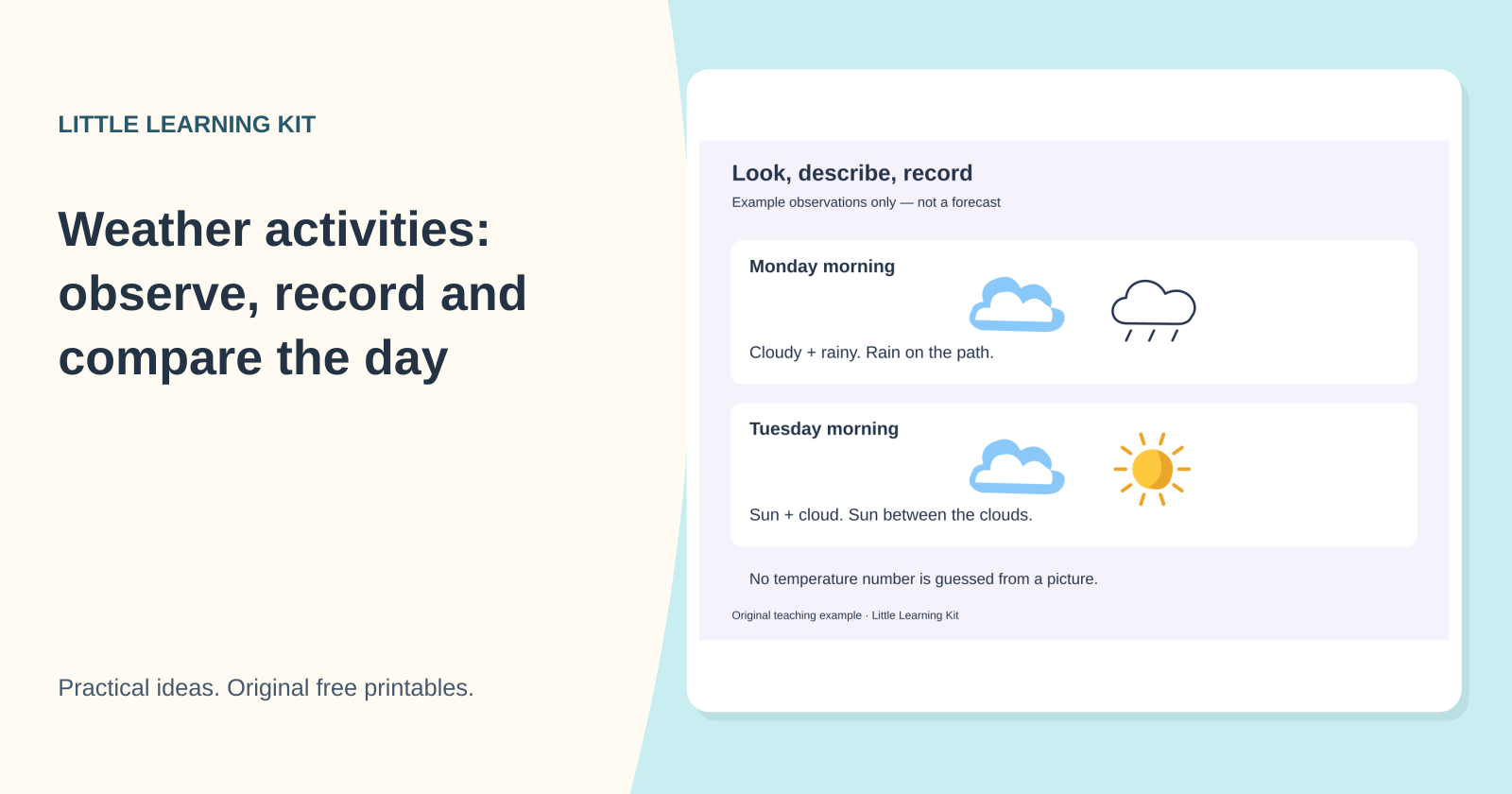
A single picture rarely describes an entire day. It can be sunny and windy at the same time, or cloudy in the morning and rainy later. Let the child select two cards when both fit. You can write cloudy with rain rather than arguing about which one is the official answer. The small record in the diagram is an invented example of observations, clearly labelled as such; it is not a forecast or a record of weather at your location.
Separate looking, feeling and measuring
Cloud cover is something you can observe by looking at the sky without looking directly at the sun. Temperature needs a measurement if you want to record a number. A sunny picture does not prove that the air is warm, and a cloudy picture does not prove that it is cold. You can say the air feels cool to you, while explaining that another person might describe the sensation differently.
If an adult uses a suitable thermometer, write the unit beside the reading. If you use a weather service, say that the number comes from that service rather than pretending you measured it at home. The Met Office observations guide explains that its observations relate to observing locations. A nearby station and your own window are not exactly the same place, so occasional differences are a reason to discuss location, not to dismiss the child's observation.

Activity one: make a daily weather row
Choose a convenient moment, such as after breakfast, and observe from roughly the same place. Add the day or date, the time if useful, a selected weather card and one short sentence. An adult can write while the child chooses a picture or dictates what they noticed. Start with three observations over several days rather than committing to a month-long project that becomes a chore.
- Look and listen from a safe place, naming one piece of evidence.
- Choose one or two cards that fit what is happening now.
- Add the date and a short observation, such as Rain is falling on the path.
- Leave a blank entry when you do not observe; do not invent a missing day's weather.
- Compare the completed rows and talk about something the same or different.
The days cards can label the rows, but the adult may do the calendar work while the child focuses on weather. If you return later and conditions have changed, add a second observation with a different time. That is clearer than erasing the morning's valid record. See the days-of-the-week guide when naming days becomes a separate interest rather than a prerequisite for this activity.
| When | Observed weather | What we noticed |
|---|---|---|
| Monday, morning | Cloudy and rainy | Rain on the path |
| Tuesday, morning | Sun and cloud | Sun appeared between clouds |
| Wednesday | Not observed | Leave blank rather than guess |
Activity two: choose clothing for a real outing
Place two or three appropriate items nearby and discuss the outing you actually plan to take. For rain, an adult might compare a waterproof coat with a jumper that can get wet. Let the child describe what the items are for, then make the real clothing decision using current conditions and adult judgement. A weather card is a conversation prompt; it should not override a forecast warning or the practical needs of the outing.
Use a fictional character when there is no outing
Draw a character heading to the park and show a rain card. Ask what it might take and why. A child may suggest a coat, boots or staying somewhere dry. Explore the reason rather than requiring one approved outfit. In a warm climate or a different season, the appropriate choices may differ. Keep the example connected to where the family lives instead of assuming that every rainy day needs the same clothes.
Activity three: turn rain observations into marks
Watch rain from indoors if it is available. Notice whether drops make small dots, longer trails on a window or circles in a puddle. On paper, invite the child to make marks inspired by one of those observations. They can use short strokes, dots or curved lines. You are making a drawing, not measuring rainfall, so avoid interpreting a denser drawing as evidence that more rain fell.
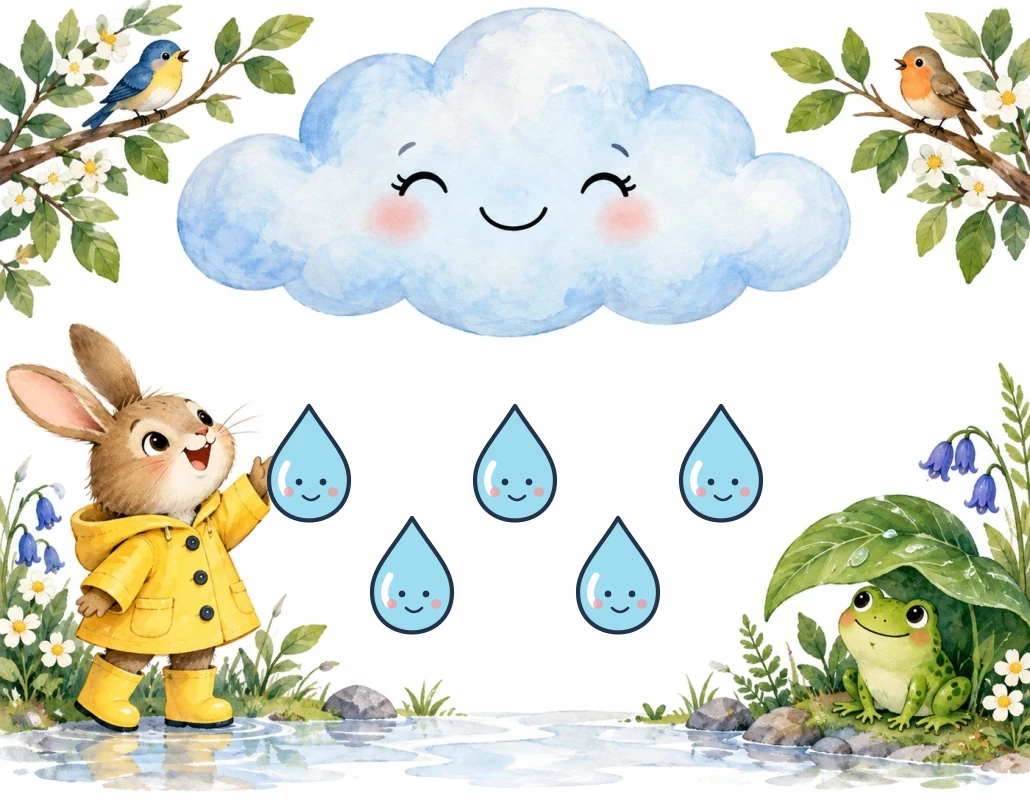
If it is dry, use the rain-cloud craft as a pretend weather scene. Its five-drop mission and seven supplied pieces are a craft choice, not a scientific model of how many drops come from a cloud. Count five pieces if you choose to follow the mission, save the two spares and let the child tell a rainy-day story. Keep craft quantities separate from claims about real weather.
Activity four: tell a changing-weather story
Choose three weather cards, such as cloud, rain and sun. Lay them in an order and tell a simple invented story: We saw clouds, then rain began, and later the sun came out. Invite the child to move the cards and create a different sequence. Explain that this is a story about possible changes. The order of the cards does not predict what tomorrow's weather will do.
Add a character and ask how the plan might change. A picnic may move indoors, or a character might watch rain through the window. A child who prefers pointing can choose the next picture while an adult narrates. Someone who enjoys detail can add a time word such as before, after or later. End after one short story, or keep the cards available for independent pretend play.
Compare records without overclaiming
After several observations, count the rows that include rain or clouds. If two symbols appear in one row, make the counting rule clear: you are counting rainy observations, not adding all symbols and calling them days. Three morning observations cannot establish what a season is usually like. They can support a modest statement such as We saw rain on two of our three checks.
A forecast describes expected future conditions; an observation records conditions noticed or measured at a time and place. You can look at tomorrow's forecast with an adult and compare it later, but label the two separately. For longer changes in plants or daylight, use the seasons guide. Keep the daily activity small enough to repeat willingly: a look, a word, a card and one useful thing to remember.
Sources & further support
General parent support, not an individual assessment or a school programme. Check your child’s setting for its chosen approach.