
Personal reassurance and accurate prediction are different questions. Preserve what helped, record what you actually notice and use appropriate professional advice for concerns.
Something can be reassuring without predicting every week
Rob remembers The Wonder Weeks as useful during early parenting. The book and regular emails offered information about development at a time when he and V were trying to work things out without the assumed family advice network. That is the experience he has shared. It is worth describing honestly without turning it into a claim that every date or prediction matched their baby.
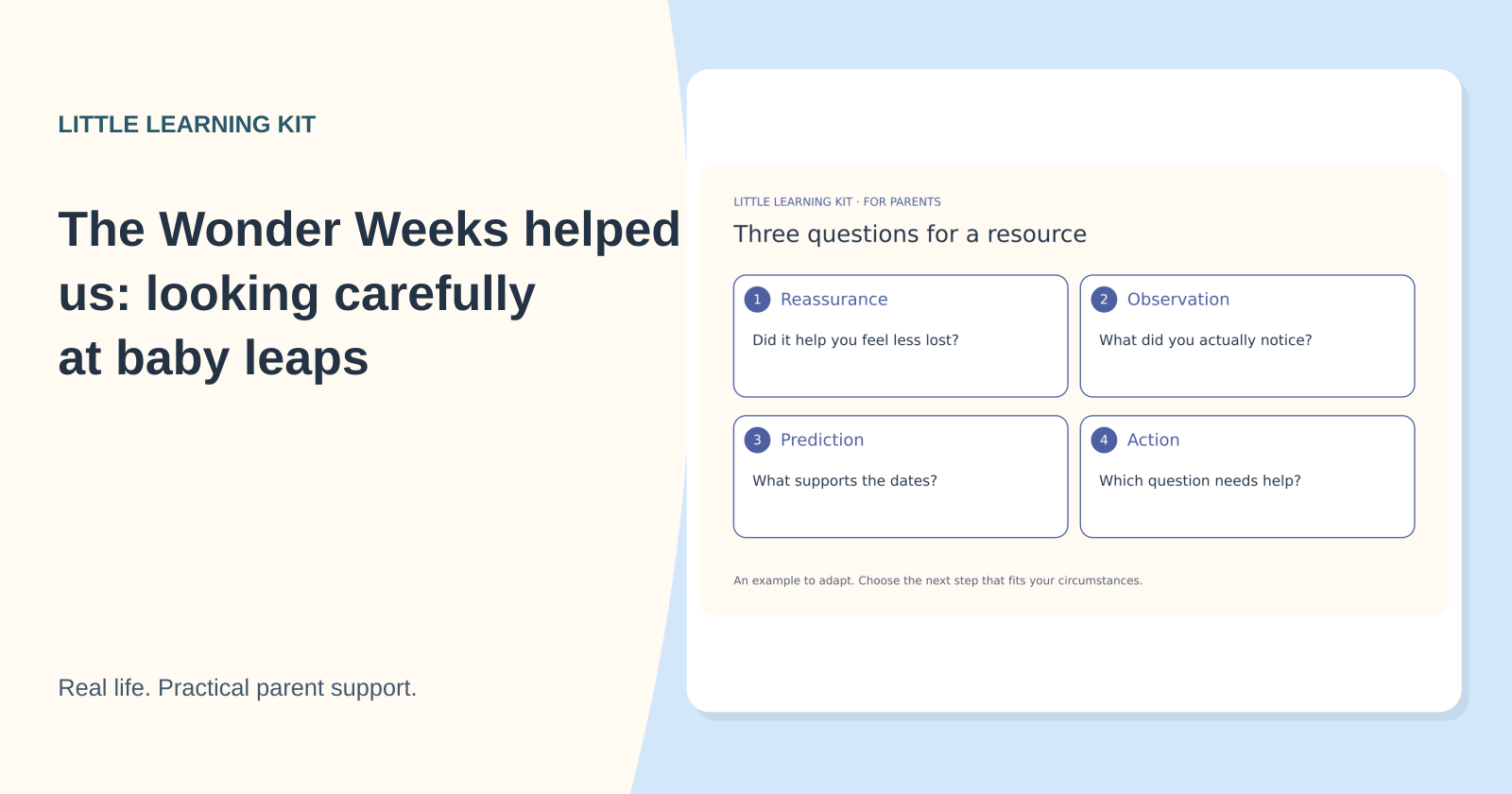
That account describes the value of the information, rather than a week-by-week test of its predictions. To understand what a resource can offer, separate three questions: did the information feel helpful, does it encourage useful observation, and how strong is the evidence for a precisely timed schedule?
Those questions can have different answers. A book may give a parent language for a confusing experience while making claims that need closer examination. You do not have to reject the reassurance you felt in order to question the prediction. Equally, a memorable match between a chart and a difficult week does not establish that the chart can reliably predict what comes next.
What people mean by baby leaps

“Baby leaps” is often used for periods when a baby appears to change quickly, especially in connection with The Wonder Weeks. The commercial programme presents a theory of mental development organised into predictable periods. When reading any resource built around that idea, distinguish its description of the theory from independent evidence that the schedule works accurately for individual babies.
The publisher's scientific history page describes supporting work and a scientific dispute. It is useful for understanding the company's account of its theory, but it also comes from the organisation selling the product. Attribution matters: “the publisher says” is a different statement from “researchers agree that every baby follows these dates.”
What the small validation study does and does not show
A 1998 study by de Weerth and van Geert followed four mother-infant pairs over fifteen months and did not support the proposed strictly timed pattern of ten periods. Its small sample is an important limit. It challenges the precision claim; it does not, by itself, settle every question about infant development or review all later research.
The cautious conclusion for a parent is narrower than either “all leaps are proven” or “babies never change in bursts.” Do not use a commercial timetable as a reliable individual forecast or as an explanation that overrides a health concern. The existence of a debate is a reason to be careful about certainty, especially where a product makes its most reassuring promises.
Notice what happened before checking the prediction
Imagine a parent who sees several difficult evenings and checks an app. The app suggests a leap, and the explanation feels like a relief. That is a hypothetical example, not a family memory. The parent could still record the actual observations separately: more crying after a particular time, a change in feeding or a new way of reaching for an object.
Recording the observation before assigning the label makes the information more useful in a conversation with a professional. “My baby has been much harder to settle for three evenings” describes something to discuss. “It is leap four” depends on accepting a theory and may obscure the details the professional needs. An explanation should help you ask better questions, not close the conversation.
- Write what you noticed in ordinary language, without choosing a leap number first.
- Note the approximate time and setting if those details seem relevant.
- Separate a new skill from a change in comfort, feeding, sleep or behaviour.
- Decide whether the observation needs a healthcare conversation rather than an app explanation.
- Keep the resource only if its information is helping you respond thoughtfully.
There is no need to turn this into a detailed research diary. A short note can be enough. Protect the baby's privacy and keep any personal health observations in appropriate private channels. You do not need to share a video publicly or upload a full record to an AI system to make the account sound credible.
Keep development and health questions on their own routes
If something concerns you, contact the appropriate healthcare service rather than waiting for the predicted leap to end. A schedule cannot assess illness, feeding problems or a change that needs attention. Follow local urgent-care advice when a concern is immediate. This article cannot determine the cause of a baby's distress or tell you that a difficult week is harmless.
For development conversations, use recognised official resources as intended. CDC explains that its milestone checklists support communication and are not diagnostic or screening tests. In the UK, NHS development reviews provide a route to discuss observations and concerns with the relevant team. A leap app should not replace those conversations.
Do not use the checklist or the app to rank babies at a parent group. Knowing that another baby appeared to do something earlier may trigger a question, but it does not provide an individual assessment. A clear observation and an appropriate next step are more useful than trying to decide whether your child is ahead of a social-media example.
A weekly message can offer a useful rhythm
There is a practical feature worth separating from the prediction: information arriving in manageable pieces. A regular message can remind an adult to look, ask a question or try a simple interaction. That format may be useful even when the date attached to a developmental theory should not be treated as an appointment your baby must keep.
You can create a similar rhythm without predicting a leap. Once a week, ask what your baby seemed interested in, what felt difficult and what you want to discuss with a professional. Keep it flexible. If the exercise makes you more anxious or consumes time you do not have, reduce it or stop. Observation is meant to help care, not become another household performance target.
Decide what you want a parenting resource to do
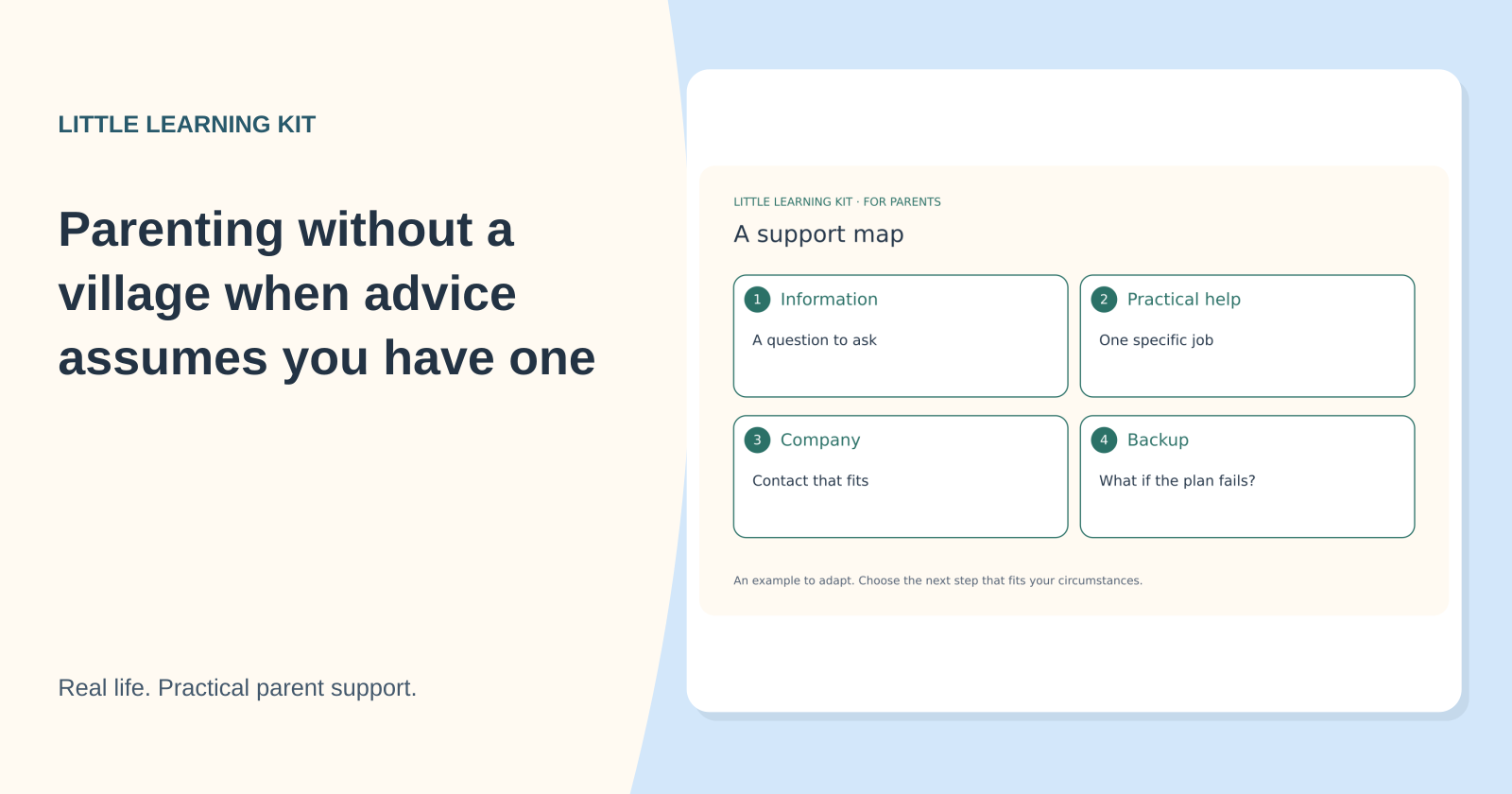
Information and practical support are different needs. Our parenting support map can help you name whether you need an answer, company or help with a specific job, rather than expecting one book or weekly message to provide everything.
Before subscribing or buying, ask whether you want reassurance, activity ideas, a record-keeping tool or professional information. Check what the product actually supplies, what it costs and how it handles your data. A resource that meets one need may not meet the others. A pleasant interface cannot turn an uncertain prediction into an established fact.
After using it, ask a concrete question: did this help me respond to my baby, or did it make me wait for an explanation from the chart? Did I feel able to ask for help when something did not fit? A resource should leave room for observations that disagree with it. If every possible outcome is described as confirming the theory, its predictive value is difficult to judge.
Rob's account remains that the book and emails helped. The responsible way to build on that is to preserve the personal value while keeping the evidence question visible. You can appreciate having felt less lost, continue noticing your baby and still avoid treating an exact developmental calendar as a substitute for the child in front of you.
Sources & further support
- The Wonder Weeks: the publisher’s scientific history
- de Weerth and van Geert (1998): strictly timed developmental transitions
- CDC: milestone checklist purpose and limitations
- NHS: baby health and development reviews
Sources checked 11 October 2026. General information; individual concerns need appropriate professional support.