
Start with the support you actually need, separate different kinds of help and make one specific request. A gap in available support is information, not a personal failure.
When the advice assumes someone is there
“Ask your mum.” “Get the grandparents to take over.” “You will work it out.” These suggestions all contain an assumption: there is someone available, someone you trust, and someone with the time or knowledge to help. When that person does not exist, the advice leaves you holding the original problem and the job of explaining why the obvious answer is unavailable.
That gap is part of the reason Rob and V wanted to write about parenting. Rob describes having to figure much of it out without the family advice network that other people seemed to take for granted. V brought a different starting point: she was raised by grandparents who taught her practical things she still values. Their experiences were different, even within the same family. Neither gives them a universal instruction manual.
Their earlier idea, Oh My Gosh Parenting, was about frank accounts of the things parents actually need help with. Little Learning Kit carries that intention into a site that already makes learning resources freely available. A printable can be useful. So can a clear explanation of what to do when the day does not resemble the tidy example on the page.
This article offers a way to describe the support you need and look for small, workable arrangements. The examples below are planning examples, not stories about Rob and V's children. You do not need to be partnered, have relatives nearby or be able to pay for childcare to use the exercise. You may also discover that the support available falls short. Naming that honestly matters.
Separate advice from practical help

Advice, company, practical help and emergency backup are different needs. One person may be good at listening but unavailable for school collection. Another might reliably bring shopping while offering advice you would rather not follow. Asking one relationship to provide everything can hide the support it can actually offer.
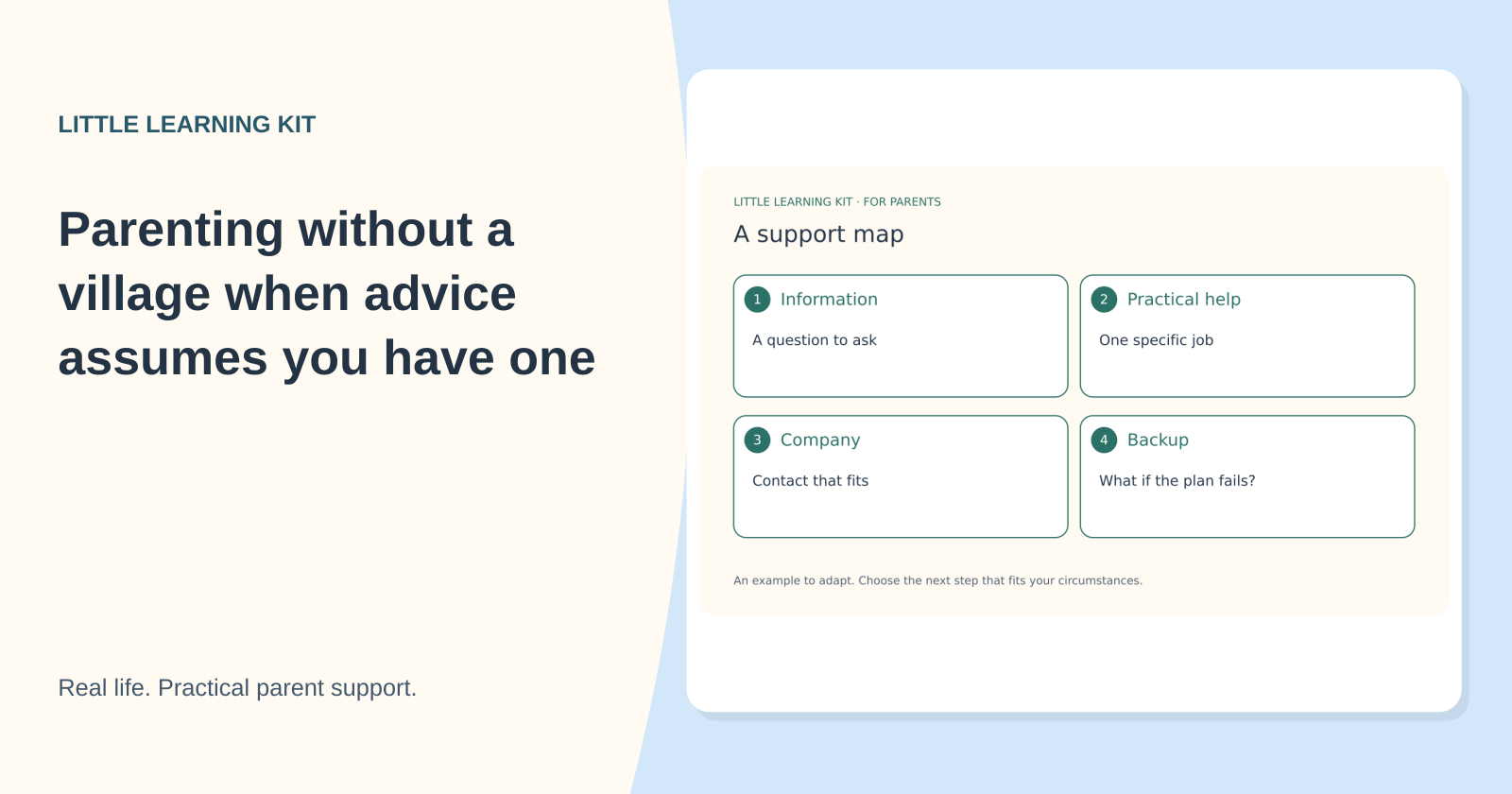
Take a sheet of paper and write those four headings. Under information, put a question you cannot currently answer. Under practical help, put a job that would change tomorrow. Under company, put the kind of contact you miss. Under backup, put the situation that worries you if your usual plan fails. Leave blanks where you need to. This is a description of your circumstances, not a measure of how well connected you are.
For information, the appropriate person depends on the question. School arrangements belong with the school. A health or development concern needs a relevant professional. A friend's experience can help you prepare questions, but their child's outcome does not settle yours. The NHS parent-support pages and CDC parenting resources provide starting points for particular questions; neither replaces a local relationship or service.
Make one request small enough to answer
“I need more help” may be completely accurate, but it leaves the listener to invent a task. A more specific request is easier to accept, decline or adjust: “Could you collect the groceries on your way past on Thursday?” Include the task, the time and any important limit. The other person should be able to understand what saying yes involves.
An example request to a friend might be: “I do not need you to solve anything. Could we have a fifteen-minute phone call after bedtime on Wednesday?” A request to a school might be: “Our usual collection arrangement has changed. Who should I speak to about the options and their costs?” Neither requires disclosing your whole family history to make the request legitimate.
Try a support plan for an ordinary week
Imagine a parent with one reliable friend, no nearby relatives and an unpredictable work finish. This is a hypothetical situation. The friend cannot provide childcare, but can exchange messages. The school has a named person to discuss collection arrangements. A local library offers a free children's session at a time that sometimes fits. That is a limited network, but its parts have different uses.
The parent could use the friend for a scheduled check-in, contact the school about a workable collection plan, and treat the library visit as optional company rather than another obligation. None of those removes the need for more childcare. The point is to avoid dismissing every available connection because it cannot provide the missing service.
- Choose one difficult point in the next seven days, rather than redesigning the whole year.
- Describe the actual job or question in a sentence, including any deadline.
- Identify the person or service most likely to address that particular need.
- Make one clear request and record the answer, including any conditions or cost.
- Write a fallback that is honest about what happens if the answer is no.
For everyday learning, the fallback may simply be doing less. A short story together can replace a whole activity plan. A visual timetable can show the few things that still need to happen. These tools organise a task; they cannot manufacture another adult, increase your income or make an inaccessible service available. You are allowed to need help beyond what a worksheet offers.
When asking has not worked
Repeatedly reaching out and getting nowhere is tiring. You do not owe every unsuitable group another attempt. Before trying again, ask what failed: timing, travel, cost, a poor response, inaccessible communication or a mismatch between the offer and the need. That detail can help you choose a different route instead of repeating an arrangement that was never workable.
If you contact a service, keep a brief record of the date, the person or team and the next agreed step. Ask what happens if you do not hear back. Where eligibility or availability is unclear, ask directly rather than spending hours building a plan around an assumption. Local services and school arrangements differ across the UK and US, and sometimes between neighbouring areas.
Where another adult shares parenting, discuss ownership as well as assistance. “Tell me what to do” still leaves one person monitoring every job. Our approach to sharing the load is to identify who notices, plans, does and checks a task. You can start with school bags or appointment administration rather than opening every unresolved household disagreement at once.
If you are parenting alone, the equivalent question is what can be simplified, deferred or obtained elsewhere. There may be no fair division available inside the home. An honest plan should say that rather than treating a missing partner as a communication problem. Some weeks the best result is protecting the essentials and putting an optional project aside.
What you can expect from this parent section
We will distinguish the experiences Rob and V have actually shared from practical examples and factual guidance. Finding a book reassuring is a real experience. It does not establish that every prediction in it is accurate. A strategy that seems sensible still needs adapting to your child, your resources and the situation in front of you.
The aim is useful detail: an example of a shorter instruction, a morning sequence with a late-start version, or wording for an awkward conversation. You should be able to see what the suggestion asks of you and decide whether it fits. There will be room for the part that remains difficult afterwards.
For today, choose one heading on your support map and write the next small request beside it. If no suitable person or service is available, write that down too. It is information about a gap in support, not proof that you failed to build the right village. Parenting already involves enough work without having to pretend that help exists when it does not.
Sources & further support
Sources checked 11 October 2026. General information; individual concerns need appropriate professional support.