
Start with a small, real group
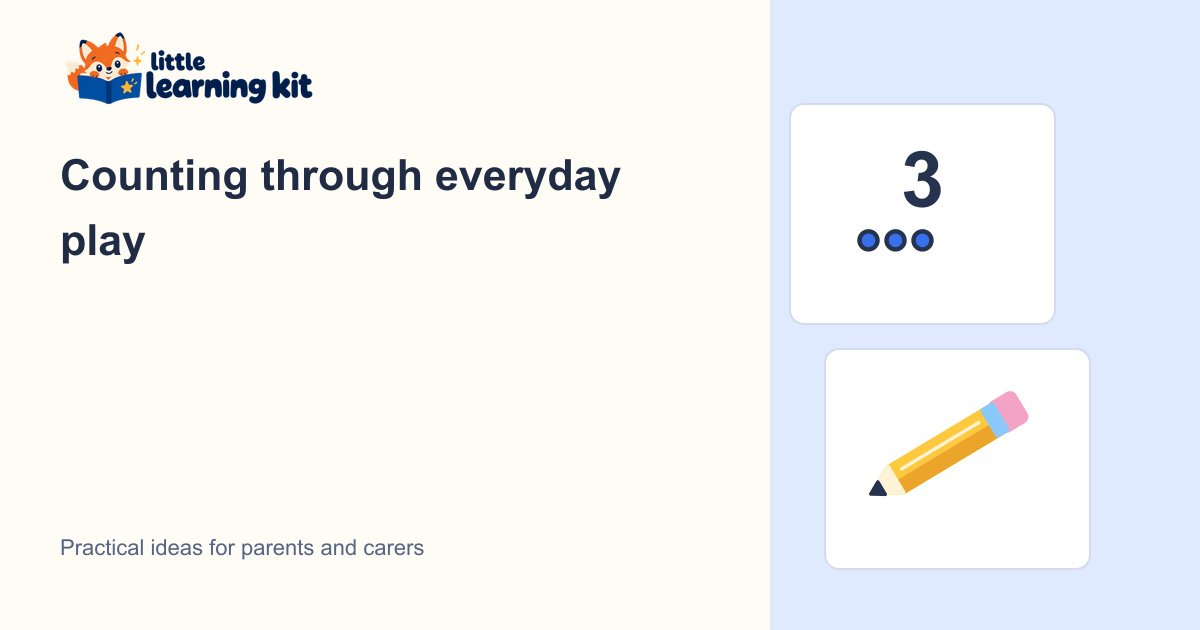
You can begin a counting game with three blocks and a few spare minutes. Put the blocks where you can both reach them and say, “Let’s see how many we have.” Touch one block for each number word, then pause: “One, two, three. Three blocks.” That last sentence makes the total clear rather than leaving the activity as a string of words.
Choose objects that are large enough to handle safely and easy to tell apart. A crowded picture or a pile of tiny items adds an extra challenge before the counting begins. Start with one, two or three objects and change the size of the group according to what your child finds comfortable. The age labels on our resources are ways to browse, not a timetable your child must follow.
Number words, symbols and amounts are different
A child might enjoy saying “one, two, three, four, five” but still count the same toy twice. Another might hand you two blocks without recognising the printed numeral 2. Both observations give you a useful next step. Keep the activity focused on one connection at a time: saying the words in order, counting a group, or choosing the symbol that matches it.
Use our number cards as labels beside real groups. Count three blocks, then put the 3 card next to them. You do not need to ask for a written number as well. If your child wants to make marks, welcome them, but leave handwriting practice for a different moment so that forming a numeral does not become a barrier to talking about the quantity.
Help each object get one count
A useful practical arrangement is an empty space on one side of the table and the objects on the other. Move one object across for each number word. The objects already counted end up in a separate group, making it easier to see what is left. You can move the objects while your child says the words, or swap those roles.
If an object gets skipped, keep the tone matter-of-fact: “I think this block missed a turn. Shall we start again?” Reduce the group if repeated recounting becomes frustrating. When using a printed sheet, slide a finger under each picture slowly. Covering unused rows with spare paper can make a busy page feel much simpler.
Three little games to try
Play toy picnic. Put out two toy animals and ask how many cups they need if each animal gets one. Match a cup to each animal before counting both groups. Add another animal when your child wants to keep going. This gives the number a job to do instead of making it an isolated question.
Play builder and helper. One person chooses a number card and the other brings that many large blocks. Begin with cards 1 to 3. Count the delivery together, then use it to build something. Reverse the roles so your child also gets to ask for an amount and watch you check your work.
Play the rearranging game. Count four objects in a line, then spread those same objects out. Ask what changed. The layout changed, but you did not add or remove anything. Let your child recount to investigate rather than insisting they should already know the answer.
For another everyday way to notice small quantities, try counting the days to a familiar event while you talk about what happens next.
Change one part of the challenge
Once a small group is familiar, there are several possible next steps. Increase the number slightly, scatter the objects, or ask your child to build a group from a card. Try one change at a time. Moving from three lined-up blocks to ten scattered pictures changes both quantity and arrangement and may be a much bigger jump than it looks.
Small quantities can sometimes be recognised without counting each item. If your child immediately says “two”, you can acknowledge that and compare it with another group of two. There is no need to demand a full recount every time. Equally, recounting is a useful way to check when someone is uncertain.
Keep it conversational
Leave room for your child to set the direction. A row of blocks may turn into a train, and the counting can become “How many carriages?” If the conversation moves elsewhere, the activity has not failed. A short, enjoyable encounter can be more useful than finishing every row on a worksheet.
For a child who uses gestures, a communication aid or another home language, offer a response that works for them. They can choose between groups, point to a card or direct your counting. If you have ongoing concerns about their learning, discuss the observations with their early-years setting or an appropriate professional rather than judging from a single game.
Choose a next step from what you notice
Suppose your child says the numbers in order but points faster than they speak. Keep the group the same size and move each block into a finished pile, pausing between moves. If they count accurately but cannot choose the numeral, leave two number cards beside the group and model the match. These are different difficulties, so they deserve different responses rather than another identical worksheet.
Suppose your child gives you a handful when you ask for two. Put two spaces on a piece of paper and invite one block into each space. Count them, remove the paper and look at the small group you made. The spaces are a temporary support; the aim is the connection between the word and the amount, not memorising where a block goes.
You can keep an informal note for yourself: “Moving blocks made it easier,” or “Three felt comfortable today.” There is no need to record a score, compare siblings or turn the note into a fixed target. Use it to choose tomorrow’s starting point. If the same game has lost its appeal, keep the small quantity and change the story around it.
Your first five-minute session
Put three large blocks and the number cards 1, 2 and 3 on a clear surface. Count one group together, find its card, then let your child choose a card for you. Finish by building with the blocks. Keep the same small set available for another day, changing the game rather than continually adding more numbers.
The practical games here are our own activity suggestions. For England-specific early-years context, Development Matters describes broad, flexible stages and cautions against using its guidance as a tick list. Your child’s setting can help you choose activities that fit their current interests and support needs.
Sources & further support
General parent support, not an individual assessment or a school programme. Check your child’s setting for its chosen approach.