
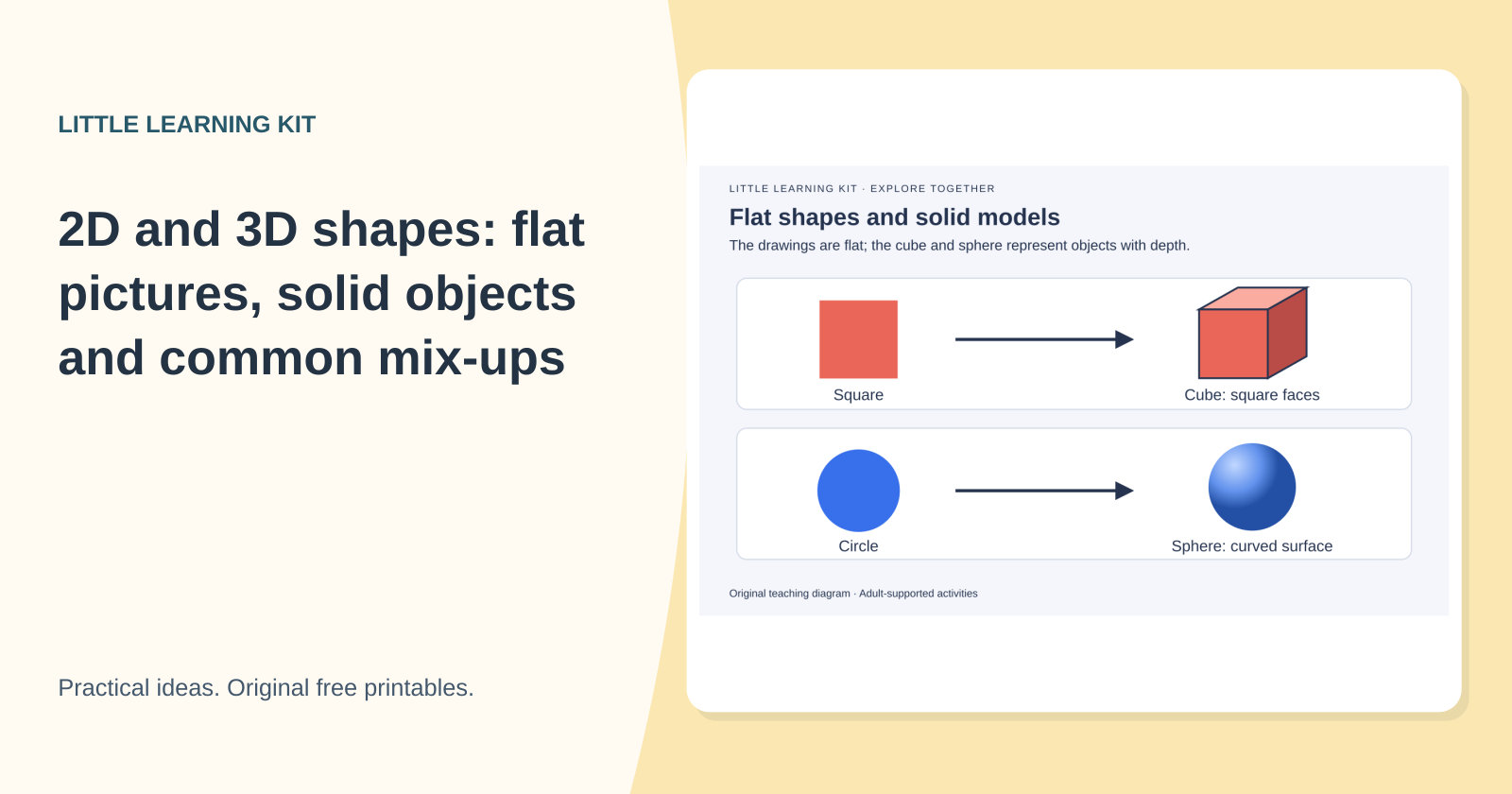
A flat shape describes an outline or surface; a solid object has depth. Pair a square card with a cube and talk about the square faces without calling the whole cube a square.
Start with a flat shape and a solid object
A two-dimensional shape has length and width; a three-dimensional solid also has depth. A square card can represent a flat square, while a cube has six square faces. Pairing the two lets a child notice the connection without calling the entire cube a square. Begin with something they can turn in their hands and a clear picture of one of its faces.
Real paper has a small thickness, so the physical card is not a perfectly two-dimensional object. Explain that you are talking about the square drawn on its surface. This distinction is useful when a child points out that they can pick the paper up. They have noticed something true. You can say, “Yes, this paper is an object. The outline we are looking at is a square.”
Gather a cube-shaped block, a ball, a plain box and two large cards showing a square and a circle. Choose clean objects that are easy to handle and appropriate for the child. You do not need a complete set of geometric solids. A few contrasting examples make the words face, curved and flat easier to connect with something visible.
Read the paired illustration
Our diagram shows a square beside a cube drawing and a circle beside a sphere drawing. Shading and visible edges help the drawings suggest depth. The diagram itself is still flat. Use it to start the discussion, then return to an actual block or ball that can be turned. A screen image cannot provide the same views or physical exploration as the object.

Compare square and cube
Put the block on a table and place the square card next to one face. Ask what looks similar. If the face is smaller than the card, acknowledge the size difference while comparing the outline. You can use the phrase square face before introducing every name associated with a cube. The important connection is between a flat region and the solid that has it.
Turn the cube slowly and find another square face. A mathematical cube has six equally sized square faces, twelve edges and eight vertices, or corners. These counts belong in the adult explanation when useful; they need not become a memory test. If you count faces together, mark or keep track of the starting face so that turning the object does not lead to counting it twice.
Make a footprint
- Place a suitable cube-shaped block on paper and let an adult help trace around its base.
- Lift it away to reveal the square outline.
- Put it down on another face and compare.
Thick pencil lines or a rounded toy block may make the drawing less exact, so describe it as a square-like footprint of that object rather than treating a rough tracing as a geometric measurement.
Try the same process with a rectangular box. It may produce a longer rectangle when resting on one face and a different rectangle on another. The box has not changed into a new solid each time. Its position has changed which face is touching the paper. This is a practical reason to turn objects and investigate more than the view shown on a flashcard.
Compare circle and sphere
Hold the circle card next to a ball. Both may look round from the front, but the ball extends away from you and has a curved surface all around it. A mathematical sphere has no flat faces, edges or vertices. An ordinary ball is a useful model, though seams, valves, dents or squeezing may mean the actual object is not a perfect sphere.
Ask your child to turn the ball and look again. Unlike the cube, there is no new square face to bring to the front. Avoid suggesting that a sphere is just a circle made thicker: thickening a circular region in one direction gives a cylinder. For an early conversation, “A circle is flat; this ball models a sphere” is enough without exploring how solids are generated.
What happens when it touches paper?
A hard ball resting on a table does not have a flat circular face like the end of a cylinder. Its outline looks circular from many viewpoints, but an outline is not the same as a face. If a soft ball leaves a small patch when pressed into paint, the material has deformed. That result should not be used to teach that every sphere has a circular flat base.
A clean cardboard tube offers a useful comparison. Its end has a circular outline, while its side curves around a length. Describe it as a tube resembling part of a cylinder, especially if it is hollow. You can compare a circle at the end with the whole object without pretending that a hollow household item is identical to an ideal solid cylinder.
Sort by a property you can test
Make two labelled spaces: has a flat face and has a curved surface. A cube-shaped block belongs in the first. A ball belongs in the second. A cylinder-shaped object can belong in both. Use overlapping spaces or a separate place labelled both; do not force every object into only one category when the rule allows two correct memberships.
For a first version, compare only a cube and a sphere. For a more exploratory version, add a cylinder and a cone-shaped object. Ask which parts support each decision. A child who places a cylinder with the cube may be attending to its flat end. Another who groups it with the ball may be attending to its curved side. Ask for the feature before deciding either answer is wrong.
Roll and slide observations
On a level, clear surface, gently move each object and describe what happens. A sphere often rolls easily. A cube tends to slide or tip when pushed. A cylinder may roll on its curved side and slide when resting on an end. These observations depend on orientation, surface and how it is moved; they are not reliable shape definitions on their own.
Keep the investigation small enough to control. A ball rolling off a table can interrupt the conversation and send children after it. Use the floor or a tray with suitable edges, and avoid steep ramps. Predict together, try the movement, then compare the result. “It rolled when we put it on this side” says more than simply putting a permanent rolls label on the object.
Answer common questions accurately
If your child asks whether a square is a rectangle, the mathematical answer is yes: a square is a rectangle with all four sides equal. The longer rectangles often used on cards are other examples of the same broader category. You can introduce that relationship gently when it arises. It is better to leave it for later than teach an absolute separation that will need undoing.
If a cube drawing seems to contain sloping diamonds, explain that the drawing shows square faces viewed at an angle. The paper picture represents how the solid might look, rather than laying out every face at its true shape and size. Let your child turn an actual cube to see the view change. This makes the drawing convention less mysterious than insisting the sloping face looks like a front-facing square.
| Flat shape | Solid model | What to notice |
|---|---|---|
| Square | Cube | Each face is square; the whole object has depth |
| Circle | Sphere | Round outline is not a flat circular face |
| Circle | Cylinder | Circular ends and a curved side |
| Rectangle | Rectangular box | Different faces may have different dimensions |
Choose the next useful resource
Use the first shapes flashcards for flat outlines and more shapes to notice for a wider comparison. Pair pictures with household models when possible. A collection of images alone can encourage children to classify the drawing style rather than inspect the solid. Keep the adult’s language tied to the particular face, edge, outline or surface under discussion.
You can finish with a child-led challenge: “Choose an object and show me one part that resembles a shape on this card.” Accept pointing, turning or a description in the child’s home language. NCETM’s shape-and-space guidance emphasises properties and different viewpoints. The goal of these original comparisons is a clearer observation, not naming every solid by a particular birthday.
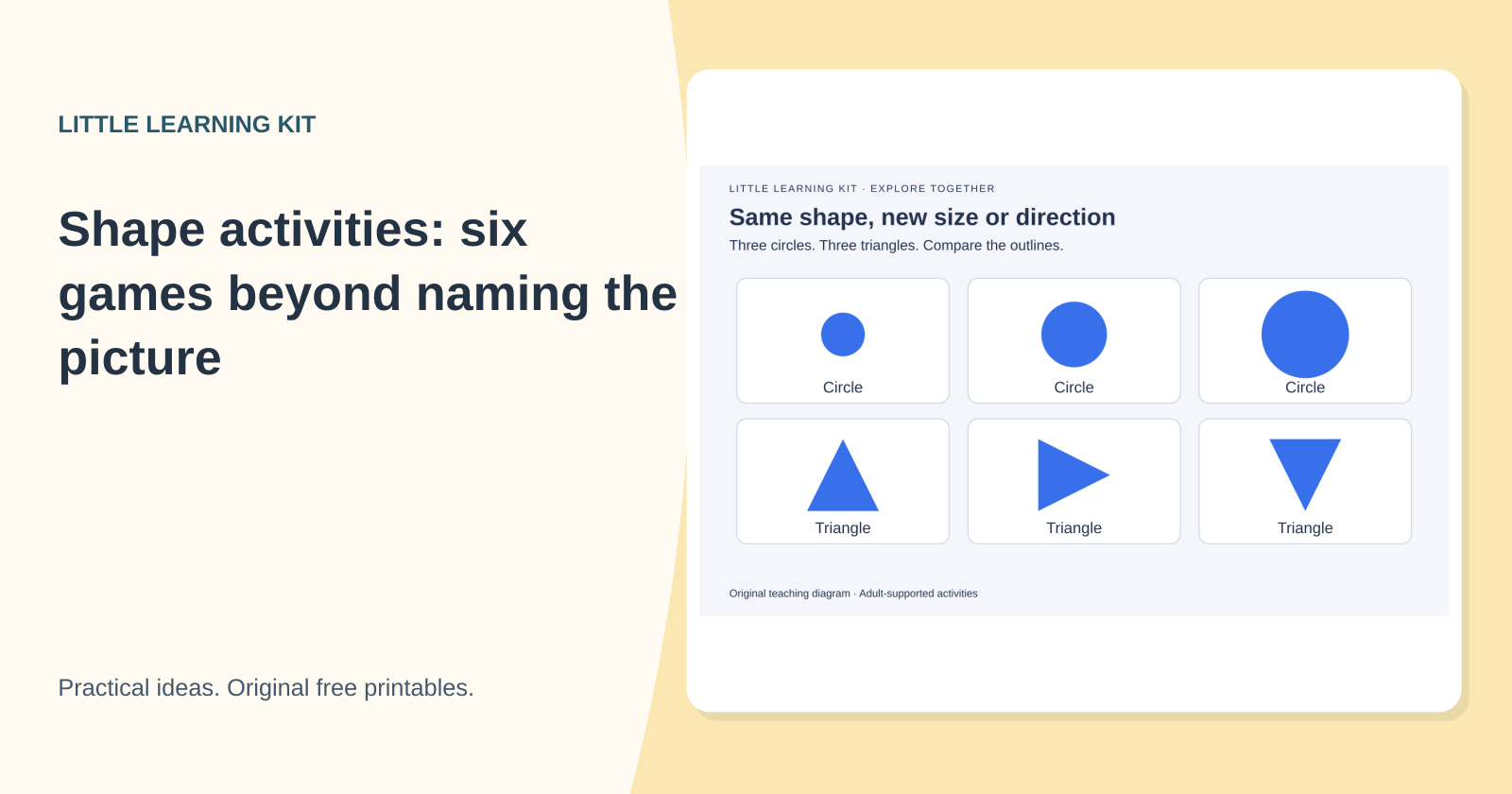
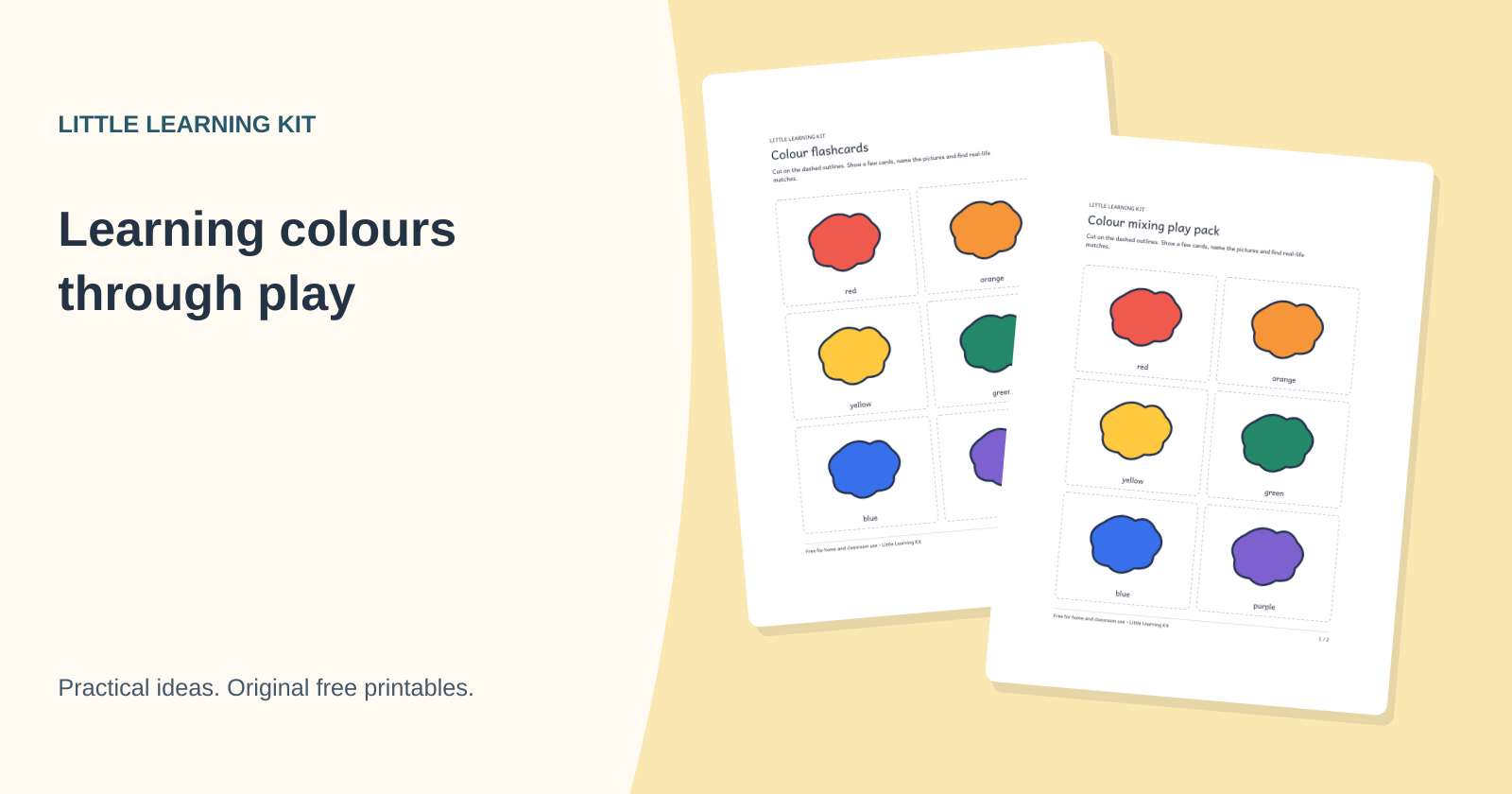
For a related next step, explore Learning colours through play or Shape activities: six games beyond naming the picture.
Sources & further support
General parent support, not an individual assessment or a school programme. Check your child’s setting for its chosen approach.