Matching and handling shapes gives children more to notice than memorising a name. Start with two familiar shapes, then change size or orientation before adding a new shape.
Start with shapes your child can handle
Shape activities become more useful when children match, turn, feel and combine the pieces. Naming is one part of the conversation. A child can notice that a triangle still fits after a turn without yet remembering the word triangle. Begin with two familiar outlines, then change their size or position before introducing a whole collection of unfamiliar names.
Use large paper cards or comfortable wooden shapes, a clear surface and a shallow tray. An adult can prepare any cut pieces. Choose materials appropriate to the child rather than small loose objects that may go into a mouth. You need enough room to move the pieces without everything overlapping; six carefully chosen cards are more useful here than a crowded pile.
Our first shapes cards can supply a starting set. Choose circles and triangles for the first round. Keep colour the same if the purpose is noticing the outline. Otherwise a child might correctly match two blue cards while overlooking that one shows a circle and the other shows a triangle. You can deliberately introduce that extra feature later.
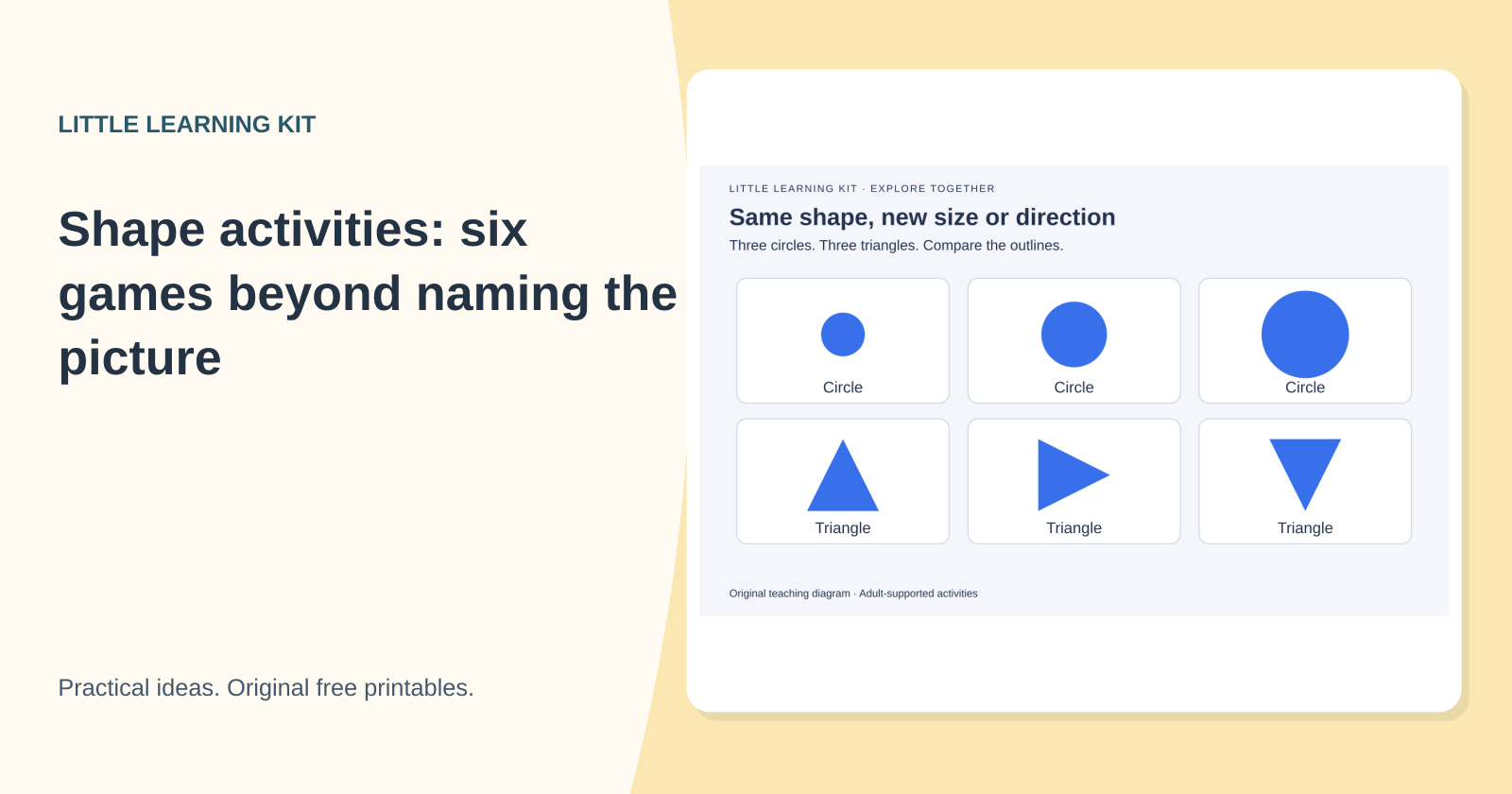
Look at the six-card example
The teaching sheet contains three circles of different sizes and three triangles in different orientations. Every triangle has three straight sides and three corners. The sideways triangle is still a triangle; turning the card does not add a side. The circles have curved boundaries without corners. Ask your child to find two shapes that belong together, then listen to what they chose to compare.

Six games with a clear purpose
1. Match an exact partner
- Put down one circle card and one triangle card, then give your child a second circle.
- Say, “Where is another one like this?”
- Let them place it beside a choice.
- Compare the outlines together.
If they choose by position or colour, place the two cards directly next to each other and trace their edges with a finger. Swap the positions before offering the next piece so that the answer is not always on the same side.
Begin with identical sizes. Once the matching action is familiar, offer a larger circle. The question becomes whether the kind of shape is the same, even though its size differs. You can say, “Both are circles; this one takes up more room.” That gives a precise description without turning the larger card into a new shape name.
2. Send a shape delivery
Create two paper destinations: a circle outline on one tray and a triangle outline on another. Give the child one card at a time to deliver. Start by showing the destination as you name it, then try giving a verbal request without pointing. Reverse roles so your child asks you to deliver a piece and checks whether you found the intended tray.
A useful mistake is an adult placing a circle in the triangle tray and pausing. Ask, “Does this delivery belong here?” Let the child correct it, describe the difference or simply move it. Keep the play cooperative. The point is to make the sorting rule visible, not to catch someone out or to demand a complete spoken explanation before accepting a correct match.
3. Find the shape after a turn
Place a triangle on a plain sheet and draw around its outline. Lift the piece, rotate it and ask your child to fit it back. They may need to turn it several times. Leave room for that trial: successful fitting involves movement as well as recognising a name. A large outline makes the task clearer than a tiny printed space with thick borders.
Next, show the triangle pointing sideways beside another pointing upward. Count their sides slowly if your child thinks the turned one is different. Do not call a rotated square a different shape simply because it rests on a corner. You can describe its position as tilted while keeping its name square. Position words and shape names answer different questions.
4. Explore a hidden shape bag
Put two large, clearly different shapes in a cloth bag. Let your child feel one, describe a feature if they wish, and bring it out to compare with the matching picture. “I feel a corner” is a useful observation even if the final name is uncertain. You can start with the object visible and partly cover it rather than immediately hiding it completely.
Use sturdy pieces that will not bend into misleading outlines. Paper triangles inside a bag can curl, which makes feeling their sides harder for reasons unrelated to shape understanding. If the child dislikes reaching into an unseen space, place a cloth over a shape on the table and let them lift a corner. Keeping the task comfortable preserves the intended comparison.
5. Build a picture from pieces
Offer a rectangle, a triangle and two circles, then invite your child to arrange a vehicle, house or imaginary creature. There is no single correct picture. Ask which piece might work for a wheel and what happens if a roof triangle is turned. Discuss the choice rather than supplying every placement. A drawing can represent an object without having exactly the same geometry as the real object.
Keep the first version movable. Gluing immediately can turn a useful experiment into a one-chance craft task. After trying two arrangements, your child can choose one to keep, draw around it or photograph it privately. If an adult records the finished picture, include the child’s description rather than replacing it with an adult interpretation of what the picture ought to be.
6. Find a shape in the room
Take one card on a short indoor search. A clock face might resemble a circle; a book cover might have a rectangular outline. Point to the particular part you mean. A box has rectangular faces, but the whole box is a solid object. This language leaves room for the distinction explored in our flat-and-solid-shape guide without requiring a technical lesson during the search.
Notice the reason behind a match
A correct name does not always show which feature the child noticed. Ask an occasional question such as, “What makes those two go together?” They might identify corners, colour, size or the picture’s meaning. Each answer tells you which rule they used. If your intended rule was shape, acknowledge the valid colour match and then clearly propose a different round using outlines.
Drawings can be ambiguous. A very rounded triangle or a square photographed at an angle may be less clear than a simple outline. Replace the image rather than insisting the child ignore what it actually shows. When introducing rectangles, remember that a square is a special rectangle; you can compare a square with a longer rectangle without teaching that the two categories can never overlap.
| Game | Materials | Adult prompt | Easier version |
|---|---|---|---|
| Match | Two card pairs | Which outline matches? | Use identical sizes |
| Delivery | Two labelled trays | Where does this go? | Point to the destination |
| Turn | Shape and outline | How could it fit? | Turn it together |
| Hidden bag | Two sturdy shapes | What can you feel? | Keep one part visible |
| Picture | Movable pieces | Which piece could work? | Offer two choices |
| Room hunt | One card | Which part looks similar? | Model one example |
Make a small mixed practice sheet
Select two familiar shapes and one shape your child wants to explore. Print enough examples to compare size and orientation, leaving white space between cards. For a cutting task, use fewer, larger items; for an older child comparing several examples, a denser sheet may be practical. The more shapes collection gives additional choices once the first set feels familiar.
Choose the next activity from the response you saw. If turning caused difficulty, repeat the fitting game with the same shapes. If naming was uncertain but matching was confident, keep playing and model the names naturally. These are flexible activities rather than age tests. NCETM’s shape guidance supports exploring movement and properties alongside vocabulary; the six routines here are original ways to put that focus into practice.
For a related next step, explore Learning colours through play or 2D and 3D shapes: flat pictures, solid objects and common mix-ups.
Sources & further support
General parent support, not an individual assessment or a school programme. Check your child’s setting for its chosen approach.