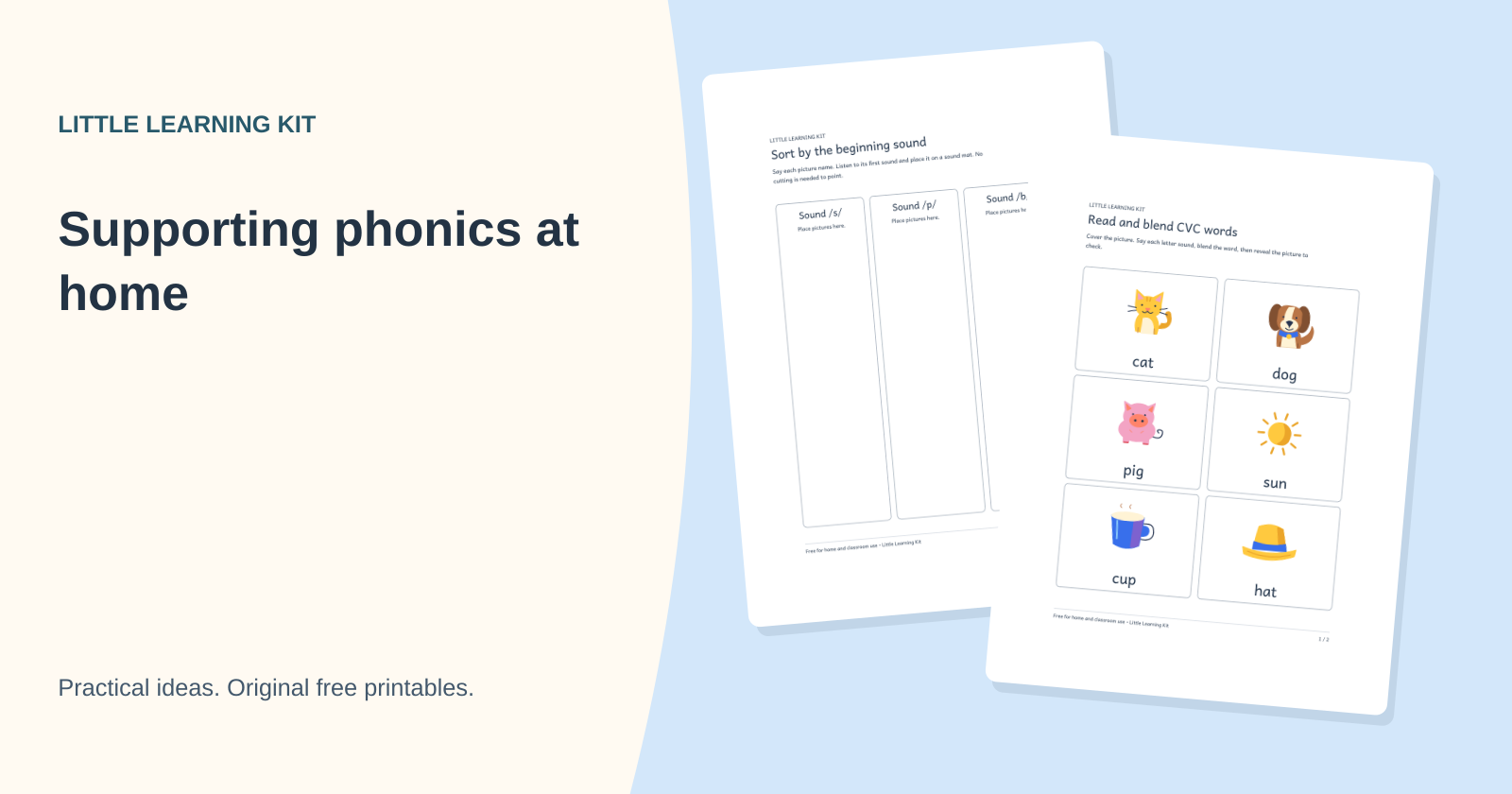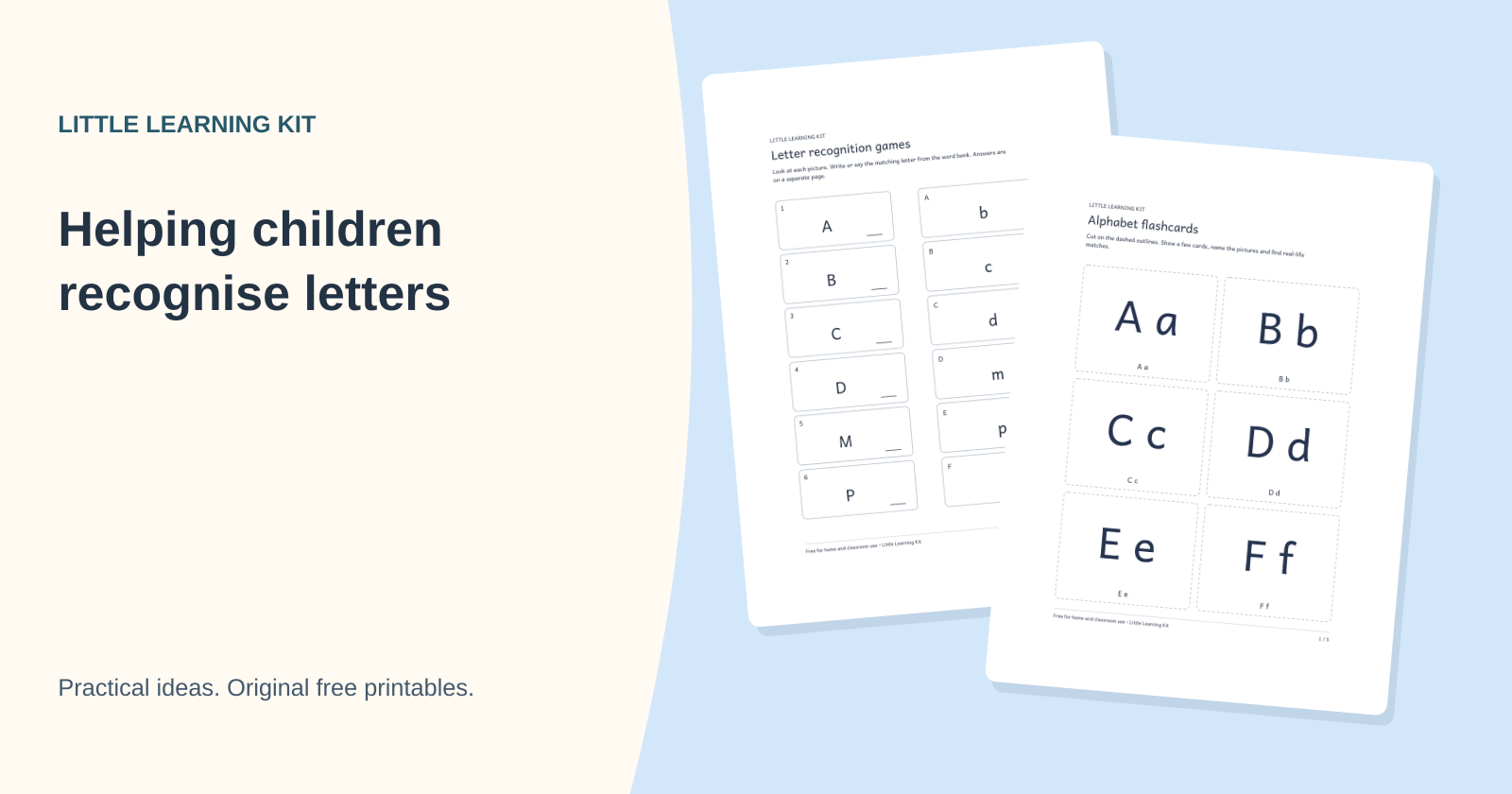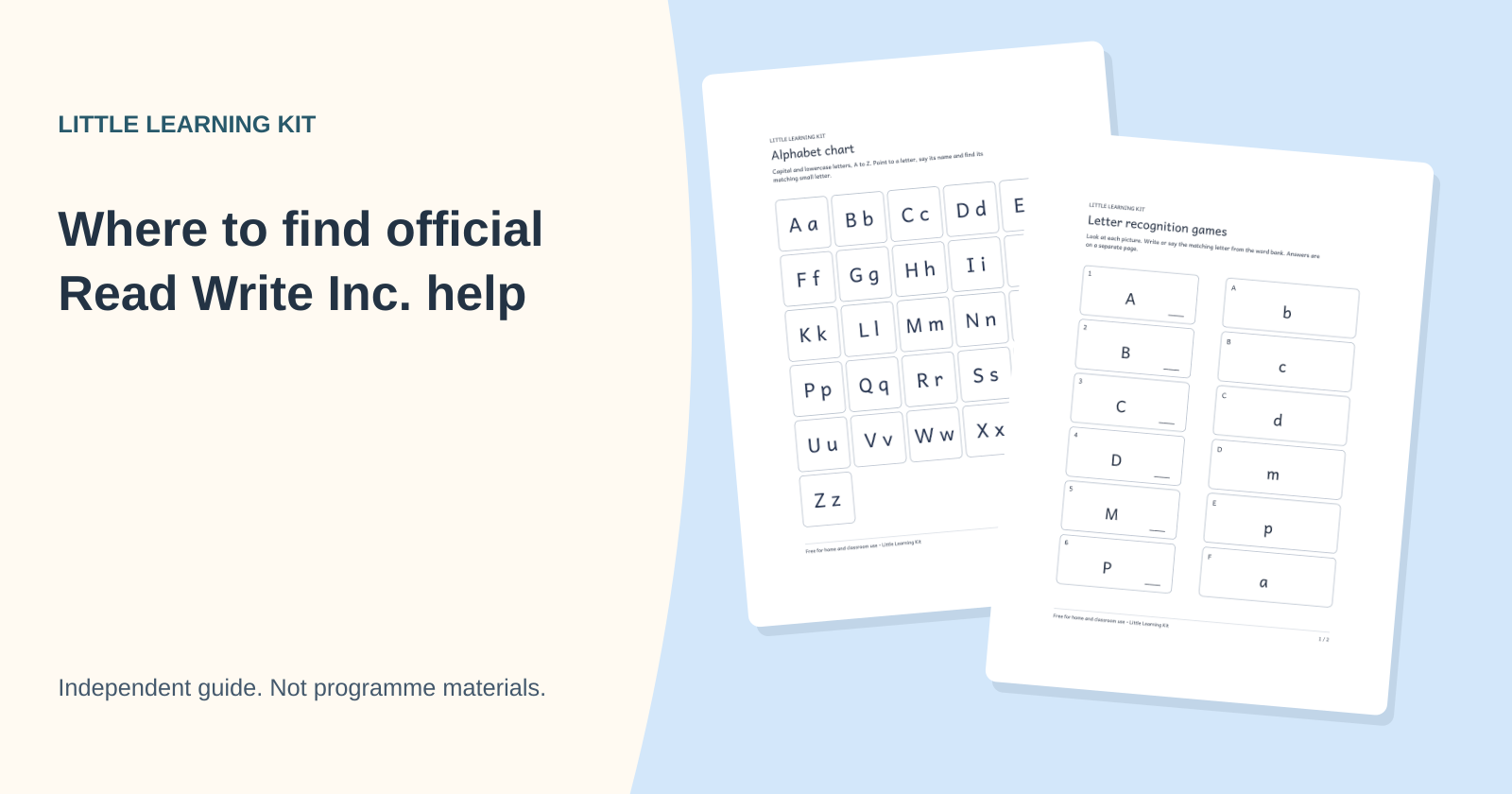
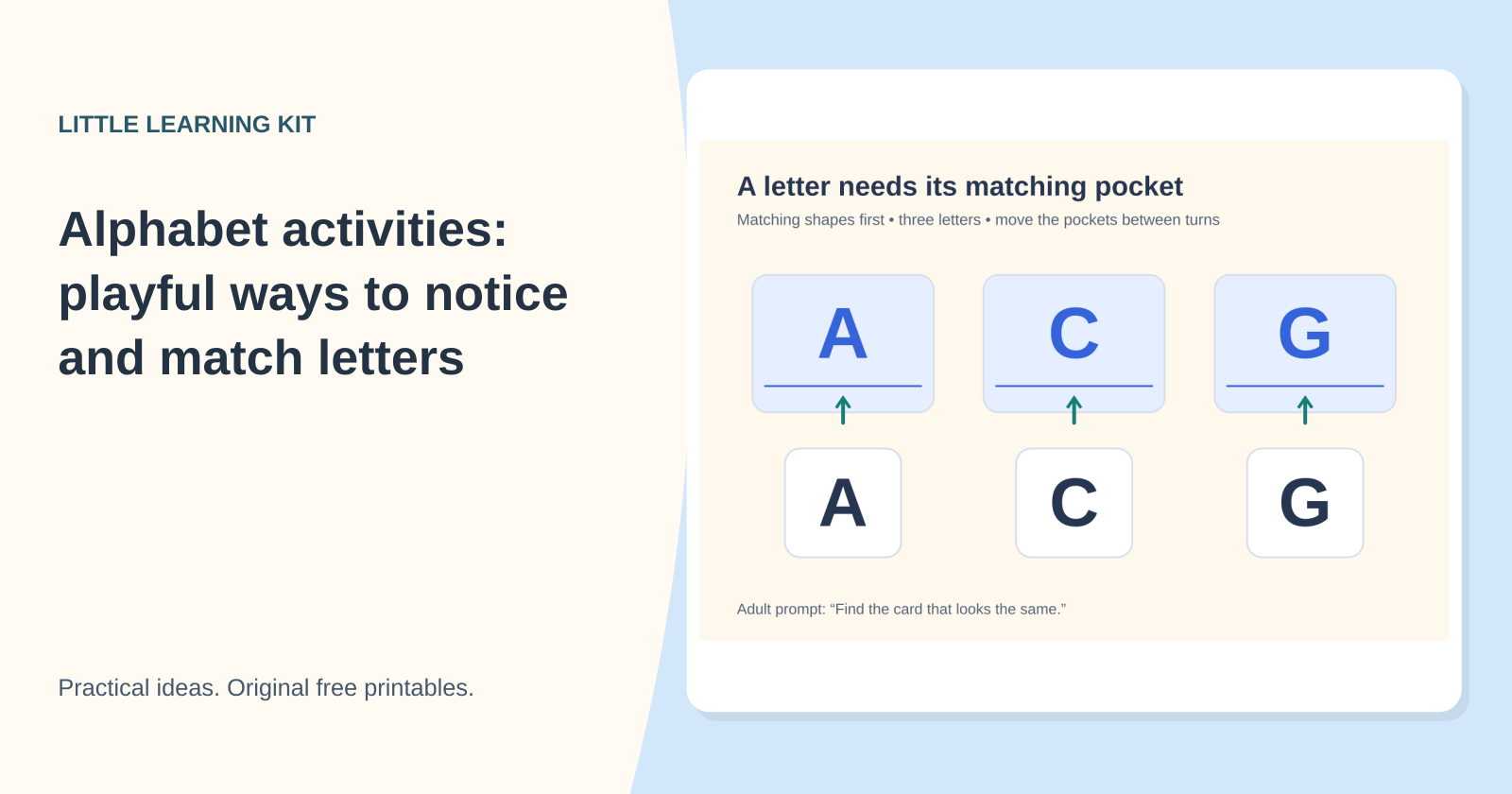
Choose a few useful letters and make them part of a game: find a match, post a letter card or spot a letter in a familiar word. Keep letter names, sounds and handwriting as separate goals.
Choose what the game is practising
Alphabet activities work best with a small set of letters and one clear purpose. A child can match two printed shapes without knowing their names, name a letter without knowing its usual sound, or recognise it without being able to write it. Choose the job first, then make the game fit. The eight activities below use ordinary paper cards rather than a large collection of equipment.
Start with two or three letters that matter to your child: perhaps the first letter of a familiar name and two visually different letters. Our worked setup uses uppercase A, C and G. These are examples, not a recommended teaching order. Print two copies of those cards from the alphabet flashcards or write clear matching forms on six large rectangles. Keep scissors and preparation with the adult.

Matching, naming and sounds
For a matching game, say, “Find the card that looks the same.” For letter names, supply the name while pointing: “This is A.” When practising a sound, use the correspondence your child has already learned and the pronunciation their setting recommends. Do not ask for all three responses on every turn. Oxford Owl explains that phonics programmes introduce sounds and spellings in different orders; check the material your setting sends home rather than treating an alphabet chart as that sequence.
Eight games with a complete starting point
1. A letter postbox
- Use three envelopes or folded paper pockets, each labelled A, C or G. Lay them open on the table with the matching cards beneath them.
- An adult models one delivery: compare the A card with each pocket label, say “These match,” and put it inside.
- Invite your child to deliver the remaining cards.
- Open the pockets together and compare the contents with their labels.
An easier version uses one pocket and a matching card beside one non-matching choice. For a harder version, move the pockets between rounds so remembering their positions is not enough. Keep the labels visible: this is visual matching, not a memory test. If posting through a slot makes handling difficult, placing a card on top counts as a complete delivery.
2. A matching path
Put three large target cards in a short line on the floor. Give your child a duplicate card and ask them to carry it to its match. Keep the route clear and use walking rather than a race. After matching, move a toy along the path while naming the letters together if your child enjoys that extra conversation.
Change the sequence on the next round. If C always comes second, the activity can become remembering a route rather than comparing print. For a seated version, make the same path across the table and slide a large toy between targets. The movement is part of the story; the actual answer is the matched letter.
3. Alphabet detective
Choose one familiar word on a book cover, such as a name your child knows. Show the target letter on a separate card, then search the word together. Say, “We are looking for this shape,” and point to the whole letter when you find it. Avoid searching a crowded page full of different fonts on the first attempt.
If the target is absent, say so and try another word. Do not bend the answer to make every search successful. Finding that a letter is not there is a useful comparison too. You can use the alphabet chart as the adult's reference, but keep the active search to one letter and one short piece of print.
4. The letter shop
Make a pretend shop with three labelled spaces and matching card stock. Your child chooses a card to order; you give them a card and both check whether it matches. Sometimes make an obvious, playful mistake and accept the correction: “You asked for C, and I gave you A. Let us compare them.”
Swap roles so your child can be the shopkeeper. An order can be shown silently, named aloud or described by its shape, depending on the chosen goal. Do not make spoken naming compulsory for a child who is demonstrating accurate matching by pointing. Keep money, prices and counting out of this first version so the letter task stays clear.
5. Letter windows
Place a large sheet with one cut-out window over a row of three cards. The adult moves the window to reveal one complete letter at a time. Your child finds its duplicate from a small choice. Show the whole letter rather than a tiny fragment; guessing from one corner introduces a different and often harder task.
Let your child move the window for your turn. If paper handling distracts from looking, remove the cover and simply point to the target. The cover is useful only when it reduces visual clutter. It is not a challenge that everyone must master before they are allowed to see the rest of the page.
6. Build a letter gallery
Offer three familiar letter cards, plain paper and drawing materials. Ask your child to choose a letter for a gallery label. They can place the card beside their picture without copying it. An adult might say, “You chose G for this gallery space,” keeping the label separate from a claim that every pictured object starts with that sound.
Later, invite them to find the same letter elsewhere in the gallery. A drawing of a sun can sit under G because this version is about recognising labels, not initial sounds. If you decide to make an initial-sound gallery instead, change the rules explicitly and agree the intended spoken name of each picture first.
7. Remember two pairs
Use only A and C with their duplicates. Begin with all four cards face up and make the pairs together. Then turn them face down in a neat square. Reveal two cards per turn, compare them, and leave a matching pair visible. Return non-matches to the same places so the memory rule is predictable.
If remembering the locations overwhelms the letter comparison, return to face-up matching. Adding a memory demand does not automatically make a better alphabet activity. You can also keep one row visible and cover only the duplicates. Stop after the two pairs are found; there is no need to expand immediately to all twenty-six letters.
8. Sort a mixed delivery
Mix the six A, C and G cards in a small pile. Place one large reference for each letter across the table. Your child takes a card, compares it with the references and places it in a matching group. Check by putting the cards side by side, not by announcing a score.
After a successful round, add one clearly different letter with its own reference. Alternatively, keep the letters and change the font on just one duplicate, explaining the new appearance before asking for a match. Do not add several fonts, lowercase forms and more letters together: you would no longer know which change made the task difficult.
Choose a game that fits today
| Game | Main job | Simple materials | Easier option |
|---|---|---|---|
| Letter postbox | Compare matching print | Three pockets and cards | One pocket, two choices |
| Detective | Find one letter in a word | One card and a book cover | Adult points to two possible places |
| Memory pairs | Match while remembering location | Four cards | Leave all cards face up |
| Mixed delivery | Sort by letter form | References and duplicate cards | Two clearly different letters |
These choices are useful because they separate the task from the theme. A child who loves vehicles can deliver the cards with a toy van. A child who prefers arranging things can make a gallery. Keep the letter comparison the same while changing the story around it. There is no need to buy a new set every time interest changes.
A short week without a daily test
On the first day, model A, C and G in the postbox game. On another day, use the same cards for a matching path. Try a detective search on a familiar cover later in the week, then let your child choose a favourite game to repeat. A missed day needs no catch-up session; the cards will still be available when the activity fits.
Notice what actually helped. Perhaps two choices were comfortable but three became confusing, or a decorative font hid the shape. Return to the clear version and introduce one change later. If the child reliably matches but does not name the letter, acknowledge the matching skill instead of treating it as wrong. Our letter recognition activities offer further matching resources; the uppercase and lowercase guide explains a separate next step when two forms are useful.
Sources & further support
General parent support, not an individual assessment or a school programme. Check your child’s setting for its chosen approach.