Begin with one useful letter
A letter becomes interesting when it belongs to something a child cares about. The first letter of their name, a familiar person’s name or a favourite book title gives you somewhere to begin. Point to it, say its name and find the matching card. There is no need to introduce the whole alphabet before that small encounter can be useful.
Choose a clear printed example rather than an elaborate logo for your first comparison. Keep the letter the same size and style on both cards if your immediate aim is finding a match. You can explore decorative lettering later. For now, let the child look, point and compare without also needing to write or pronounce anything on demand.
Recognising, naming and writing are different jobs
Recognising a letter means noticing the same letter when it appears again. Naming it adds a spoken label. Writing it adds a separate movement task. A child might match two cards accurately but not recall the letter name, or recognise a letter in their name without being able to form it with a pencil. Choose the activity that matches the connection you want to explore.
Phonics is another related task: connecting written letters with speech sounds. Oxford Owl’s phonics overview explains that relationship. If you are playing a letter-name game, name it as such; if you are practising sounds, use the approach supplied by the school. Do not expect an alphabet chart to explain every sound that a letter or group of letters can represent.
When your child is ready to explore letters as sounds, read our calm guide to supporting phonics at home and follow the sequence supplied by their setting.
Try a three-pair matching game
Print two copies of three letter cards, such as A, M and S. Place one set in a row and offer the second set one card at a time. Show how to put the matching card beneath its partner. Leave all the cards face up so this is a looking game rather than a memory challenge. Say the letter name when you make a match.
If choosing between three is difficult, reduce the choice to two and move the matching cards closer together. If it feels straightforward, change their positions or choose a fourth letter. An adult can move the cards while the child points or gives directions. The response does not have to involve holding a small piece of paper.
Connect capitals with lowercase partners
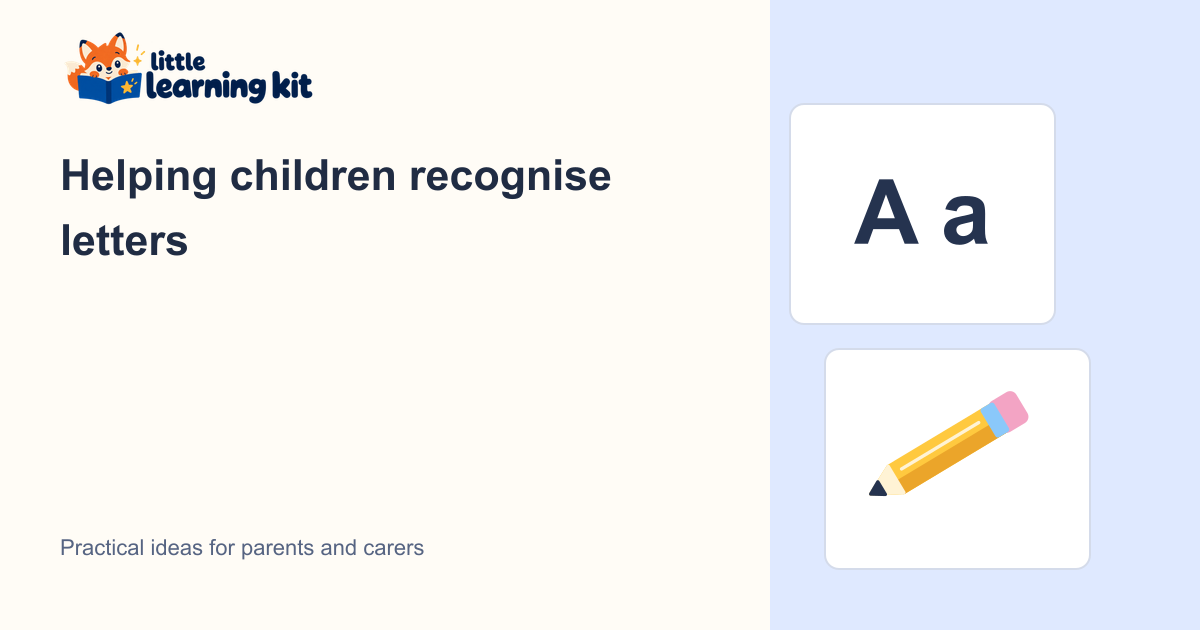
A capital A and a lowercase a look different but are forms of the same letter. Begin with both visible on a reference card. Point to each form, say the letter name and explain the partnership. Then look for one form in a book. Some pairs look very similar, while others need more deliberate comparison.
For a practical game, keep the paired reference nearby and offer separate capital and lowercase examples. Let the child check rather than hiding the reference to make things harder. Once a pair is familiar, try it in another typeface. A printed a or g may look different in another book; notice that difference together instead of treating the familiar example as the only possible form.
Look for letters in a small area
Choose one page, one book cover or one labelled container for a letter hunt. Say which letter you are looking for and leave its card beside the example. Scan slowly together. A whole room of labels can be overwhelming, whereas a single book cover gives the game a clear beginning and end.
When you find a match, ask what helped you notice it. You might point to a straight line, a curve or a familiar overall shape. Avoid making a rule from one font detail that changes in another typeface. Then switch roles: your child picks a card and you do the searching, explaining your choices aloud.
Take similar-looking letters slowly
When two forms are easily confused, place them side by side and look at what is the same and what is different. For example, lowercase b and d both contain a tall line and a rounded part, arranged differently. Keep the reference close and match one at a time. A rushing game adds pressure without making the difference clearer.
If the child is learning to write these letters at school, ask which formation guidance the teacher uses rather than inventing a competing rhyme. For a recognition activity, pointing and matching are enough. Repeated uncertainty is a reason to model again or simplify the choice, not a basis for diagnosing a difficulty from one afternoon’s game.
Choose the resource with the right job
Use the alphabet chart when you want a single reference showing all the pairs. Use alphabet flashcards when you want to select a small set, move cards around or make a matching game. The letter-recognition activity offers a ready-made matching task. Individual letter packs can provide a focused follow-up once a letter has become interesting.
The name-writing tool serves a different purpose. It makes an example, light tracing and space for a writing attempt. A child can enjoy the recognition games without moving straight on to writing. Keep the name sheet for a moment when making marks is welcome, and follow the child’s setting on the preferred handwriting style.
Make a simple letter postbox game
Put two labelled sheets on the table as pretend postboxes and give each one a different letter. Offer a few matching cards as pretend post. Your child can deliver a card to the sheet with the same letter, and an adult can read the label as it arrives. Keep the labels visible throughout so there is a clear model to compare.
If your child changes the story, let the game become theirs. A letter might be delivered to a toy or placed in a pretend shop instead. Keep the matching task small within the story, and let an adult do any moving, cutting or writing that is not comfortable for the child.
A small plan for the next few days
On the first occasion, find a familiar letter and match it to a card. Next time, match the same letter in a second place. On another day, introduce its capital or lowercase partner with a reference beside it. This is an example sequence you can adapt, not a schedule with a required number of successful answers.
Notice what made the task comfortable: fewer choices, a larger picture, a meaningful name or an adult taking a turn. Keep that feature when choosing another activity. If your child prefers a story, follow the story; letters will still be there to revisit. If you have ongoing concerns, share specific observations with the setting and ask for an appropriate next step.
Sources & further support
General parent support, not an individual assessment or a school programme. Check your child’s setting for its chosen approach.