
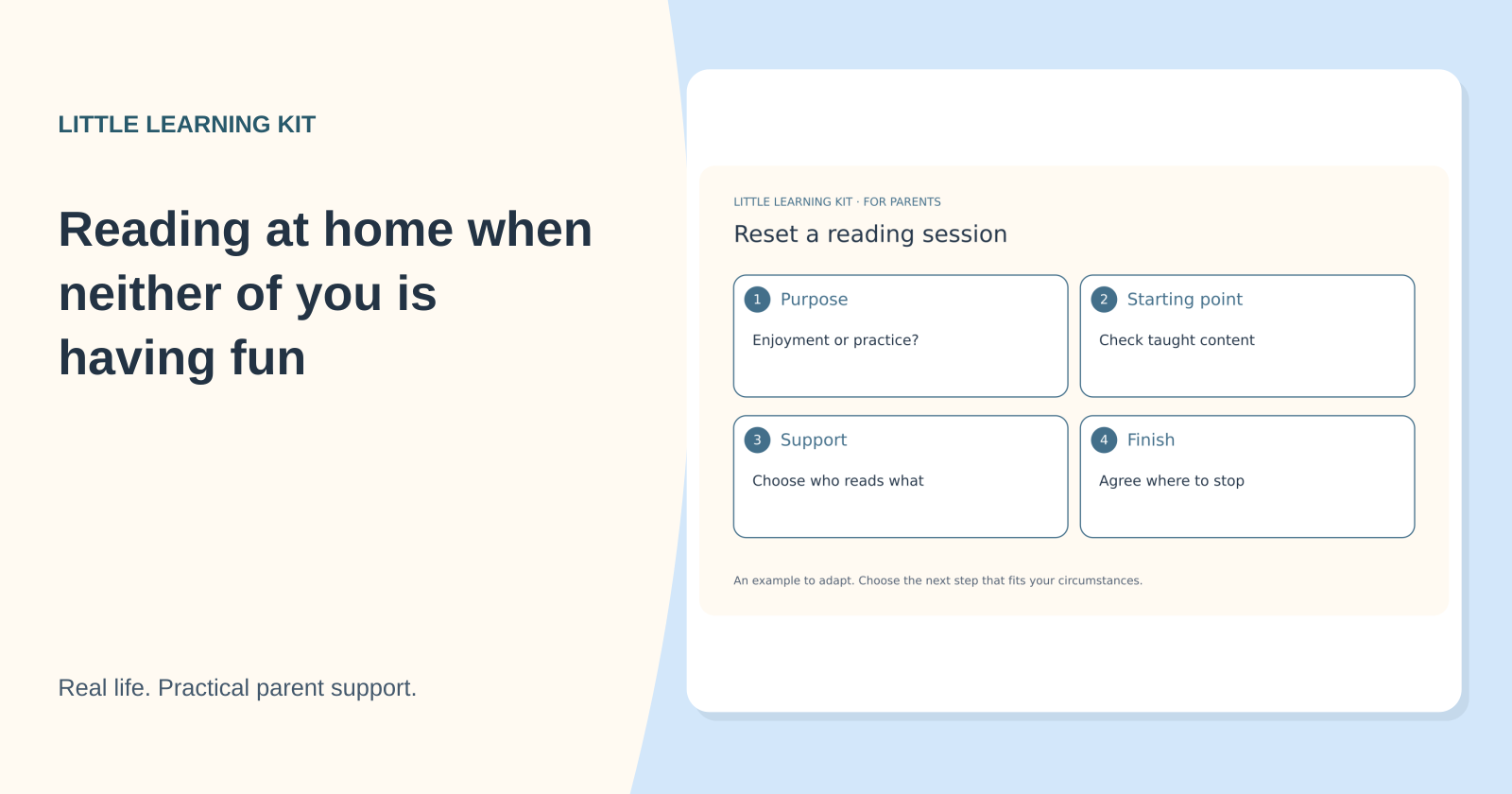
Check the purpose and the text before judging the effort. Choose a small stopping point, use the school’s approach and take a specific observation back when needed.
When opening the book starts the argument
The book is short. The adult thinks it should take a few minutes. The child sees it coming and says no. Before long, a reading task has turned into a disagreement about trying hard enough, and neither person is enjoying the story. At that point, adding another page is not the only decision available to you.
Start by separating two purposes: enjoying a book together and practising a particular reading skill. A child can listen to a story that they cannot yet read independently. A practice text needs to fit what they have been taught. Mixing those purposes can leave the adult expecting independent reading where the child needs a reader, a model or a different starting point.
The worked example below follows a difficult home session. It does not identify the reason for a child's reading difficulty. It offers a way to shorten the immediate task, describe what happened and ask the school a more useful question than “Why won't they read?”
Check the book before judging the effort

Look at the spellings, words and instructions in the text. A short sentence can contain an unfamiliar spelling. A familiar picture can make the scene understandable without making every printed word readable. If your child is learning through a school programme, ask which sounds and spellings have been introduced and what help the school wants you to give at home.
Our phonics-at-home guide covers the teaching questions in more detail. The purpose here is the experience of the session. You do not need to become the teacher of an alternative programme in order to respond helpfully. Consistency with the child's setting is more useful than combining several videos and hoping their terminology matches.
Choose who is doing the reading
For a read-aloud, the adult can take the text while the child listens, comments or looks at the pictures. Reading Rockets' family literacy resources distinguish several ways adults can support reading, including reading aloud. Keep the expectation clear: listening to a story does not require the child to earn the next page by decoding a word first.
For practice, choose a small task the child has the knowledge to attempt. Tell them where it ends: a line, a page or a particular set of words, depending on the guidance you have. Avoid promising “one more” and then extending the task because it has finally started going well. A trustworthy stopping point matters to the next session too.
A worked reset after a difficult start
Imagine an adult who has asked for a whole book after a tiring school day. The child stumbles over an unfamiliar spelling, guesses, is corrected and pushes the book away. In this hypothetical example, the adult pauses the practice instead of treating the pushed book as proof of laziness. They check what the child was expected to know and change the task.
One sample response is: “This has got difficult. I will read this story today. Tomorrow we can check which part your teacher wants us to practise.” That is different from promising that reading will never be hard. It acknowledges that this session is not giving useful information while both people are upset. The adult can still follow up rather than quietly abandoning support.
- Pause and name the immediate difficulty without labelling the child.
- Decide whether this moment is for shared enjoyment or a small practice task.
- Check the taught sounds and words before selecting independent reading.
- State a clear stopping point and provide the agreed kind of help.
- Note one specific question for the school if the difficulty continues.
At a later, more workable time, the example adult might offer a familiar line and ask the child to read it with the support their school recommends. The adult supplies a word outside the taught content rather than asking the child to guess from a picture. If the child remains distressed, the session can stop and the question can go back to the teacher. The aim is useful practice, not finishing at any cost.
Change one demand at a time
Time of day, text difficulty, length, noise, adult correction and the pressure of being watched can all change a session. You do not need to redesign them simultaneously. If you shorten the task and change the book and add a reward and move the session, it becomes harder to know which change helped or what the child found difficult.
Try one adjustment that fits the observation. If practice after school is repeatedly too much, ask whether another time or a shorter expectation is appropriate. If the task contains unfamiliar content, seek a suitable text. If the child can read quietly but dislikes a large audience, reduce the audience. These are practical hypotheses, not diagnoses.
Our little reading stories list their starting sounds and additional words. Check those details before choosing one. The grown-up can read the title and supply unfamiliar words as indicated. A free printable is useful only if it fits the current purpose; there is no need to complete the whole collection or treat the age label as an individual assessment.
Give feedback the child can recognise
“You went back and tried that word again” describes an action. “You are the best reader” creates a much bigger claim and may not match how the child feels. You can notice a strategy, a question or a small attempt without asking the child to agree that the whole session was wonderful.
If a certificate would appeal, let the child choose whether to use one and what it marks. “For revisiting a tricky word” is more specific than “For being good.” Keep it separate from making reading a performance for an award. Some children would rather choose the next story, tell someone what they noticed or simply finish and move on.
Take a useful description to the school
Record a brief observation rather than a verdict: “On three evenings this week, the first page went comfortably and the child became upset at words with this spelling.” Include the kind of help you gave and whether the same text has been comfortable elsewhere. That gives the teacher a starting point for adjusting support.
Ask which text to use, which words to supply, how to respond to an error and how long the school expects the practice to be. If the answer assumes a routine your household cannot manage, say so. A plan for an adult working late or caring for several children may need a different arrangement from the example in the handout.
Continuing concerns deserve follow-up, including any worries about vision, hearing or learning. Discuss those with the relevant professional rather than diagnosing from a reluctance to read. Avoid waiting indefinitely for enjoyment to fix a skill difficulty, but also avoid treating every tired evening as evidence of a disorder.
For tonight, you can put the practice question aside long enough to share a story in a way both of you can manage. Tomorrow, choose one smaller task or ask one clearer question. Reading at home can include effort and frustration without becoming a daily test of the child's character or the adult's commitment.
Sources & further support
Sources checked 11 October 2026. General information; individual concerns need appropriate professional support.